Category Archives: Thomas Davis

I Shall Put Upon Your Shoulders

by Thomas Davis

I shall put upon your shoulders
The cloak of the hills,
And at your feet I shall put the mountains
Clothed with the light of early dawn.

With joy I will gather up the blue waters
From the nestling lakes of the valleys
And turn the blue waters into gems,
Rare and beautiful, for you to wear.

6 Comments

Filed under Poetry, Thomas Davis

31. Doubt

an epic poem, The Dragon Epic, by Thomas Davis

Ruarther struggled to his feet confused, his head
A swirling pit of vertigo that made
Him feel as if he’d left the world and found
A state of being where the dead and living
Danced crazily between reality
And purgatory’s gray, miasmic void.
The sun was going down, and as he thought
About the spirit bear and how its strength
Had battered him, attempting to possess
The self he knew was who he’d always been,
He also knew the night would rage with cold
And threaten him with all the swirling mass
That made it difficult for him to stand.
He had to find a sheltered place to build
A fire or else not see another dawn.

At last he stood, a tottering old man
Whose will to live was interlinked with rage
Against a child he’d never even seen.
The thought that he had never seen the child,
Who plagued him like a meme, caught in his head
And echoed from his thought into his breath.
Disquiet made the swirling chaos sing.
He felt his body weave as if a wave
Flowed underneath the snow, unsteadying
His capability to stand upright.
He had to move, he thought. Before he fell.

He took a step toward the mountains, paused,
Then forced another step, the day’s last light
So blinding that he turned his head away.
Out of the corner of his eye he glimpsed
A copse of pines dark in the sunset’s fire.
He changed direction, stumbled awkwardly
Across the hard-crust snow toward the pines.

And then he stopped. He felt the spirit bear
Inside the murkiness in front of him.
The bear was in the void, a monstrous shape
That had no form, but whirled into a wind
That was no wind, a shape that struggled through
A turbulence that formed a boundary
Against its will and need to be alive.
Ruarther braced himself to feel the strength
The bear could batter at his grasp of self.
The bear had healed his body. Now it stalked
Him as he tried to find a place to start a fire.
The turbulence grew larger as it swirled,
But then it disappeared as if its winds
Had flashed into the void, the bear’s dark home.
There was no sense the witch was near to where
Ruarther forced his legs to move again.
He concentrated on the copse of pines
And lost the sense of fear he’d felt for days.
He felt as if a weight had been removed.
He touched the bow inside its case and smiled.

He stopped again. Above the mountain peaks
A black dot flew toward him through the air.
He felt malevolence that emanated
From where the dragon flashed the sunset’s fire
Off coal black wings a score of miles away.
He did not want to be upon the plains
Defenseless as the dragon hunted prey.
He forced himself to run toward the copse.

The time was near, he told himself. He felt
The dragons practicing their ancient skills,
Anticipating how they, at long last,
Could end continuance of human life.
He had to kill the witches’ child, he thought.
He had to end the threat all humans faced.

At last the pines grew larger as he ran.
He gasped for breath and tried to keep the world
From reaching up and slamming him to ground.
The pine trees welcomed him into their dusk.
He found a sheltered spot beside a trunk
Long fallen to the ground and built a fire.
As fingers trembled just above the flame,
He wondered why he thought the child had sent
The dragon searching for him in the woods.
The dragon had not said the child had sent
Her with intent to frighten him with flame.
The witch was dead. That’s what the dragon said.
The child was young and needed human care.

Perhaps the child was dead, he thought. Perhaps…
But then he felt the child across the miles
Inside her cottage by a warming fire.
He tried to puzzle out the feeling that he had,
But all he knew was that the child still lived.

There was a link between the golden dragon
And witches’ child, he thought. The coal black dragon
Was deep in plans for devastating war.

He stared at how the fire he’d built woke up
The dark and made it dance with leaping shadows.
Doubts gnawed at him inside the shadow dance.
He looked up at the sky. The waning moon
Cast little light, intensified the cold.
He took his blankets from his deer hide pack
And put more wood upon the growing fire.

He’d make the peace, he told himself. I’ll kill
The witches’ child and end the dragon threat.
He wondered why the spirit bear was blocked
From coming to the earth and walking where
Its kind had always walked through haunted light.

To listen to this section of the epic, click on Doubt.

Note: This is the thirty-first section of a long narrative poem, which has grown into The Dragon Epic. Inspired by John Keats’ long narrative poem, Lamia, it tells a story set in ancient times when dragons and humans were at peace. Click on the numbers below to reach other sections, or go to the Categories box to the right under The Dragon Epic. Click on Dragonflies, Dragons and Her Mother’s Death to go to the beginning and read forward. Go to Valley of the Scorched Black Stones to go to the section previous to this one.

4 Comments

Filed under Poetry, The Dragon Epic, Thomas Davis

A Tall, Thin-Necked Giraffe

a children’s poem by Thomas Davis

I saw a thin-necked, brown giraffe
Walk through my tallest, night-long dreams,
Its long legs flowing like the wind,
Its neck as thin as desert streams.

“Say,” I said. “Please, oh tell me, sir.
What are you doing in my dreams?
My dreams are full of dancing stars
And not giraffes brown, thin, and lean.”

The brown giraffe then looked around,
As if it hadn’t really looked,
And then it bolted from my dream
Into the pages of this book.

6 Comments

Filed under Poetry, Thomas Davis

30. Valley of the Scorched Black Stones

an epic poem, The Dragon Epic, by Thomas Davis

The great black dragon banked and hurtled down
Toward the ring of valley stones, his silence
So disciplined and fierce it seemed a fire
Inside his belly ready to be flamed.
Behind his plummeting Ssshraann and eight
Great dragons followed, silent, disciplined,
Intent on coming on their enemy
So unexpectedly that he would have no time
To organize an orderly defense.
A hundred feet above the stone, Sshruunak
Swerved hard, his flame scorched black into the circle
Inside the cold, black stones, and soared back up
Into the air, each dragon following,
Emitting flame at different spots pre-planned
Before the drill had started in the dark.
Around the stones the earth was bare and soft
In spite of ten foot snows inside the valley.

Sshruunak veered from the circle to a pattern
Where claws extended to the ground and flame
Burst down into the hordes of made-up men,
Death chortling inside his hearts as chaos
Defeated enemies as old as dragonkind.
Behind him every dragon took a pattern
That spiraled from the center out to points
Designed the make the enemy despair.
Sshruunak then trumpeted retreat and flew
Toward the rendezvous inside a hollow
Below a great, snow covered mountain peak.

Inside the hollow in a wind that howled,
He grinned to see each dragon land exactly
As he had ordered them to land, their eyes
Awhirl with colors fiery with delight.
The dragons planned. Their days of passiveness
Inside the mountain caves were nearly done.
The joy of rage and battle lust was burning
In dragon hearts and dragon strength again.

The eight great males around him waited, eyes
Locked on his eyes, their frenzy disciplined
By how he’d forged their senses to his will.

“We’re ready,” he announced, his triumph edged
Into his voice. “We’ll wait until the moon
Is new and blacker than my scales, then strike
The village near to where we’ve cowered all
The years since Mmirrimann invoked his peace.
We’ll see how strong our tactics are before
We use our skills and strength to decimate
The King of Tryon’s vaunted capital.”
He paused. “We’ll win this war and start to end
The human’s dominance,” he said. “But when
We burn the village to the ground, we need
To see that every human in the village dies.
We need to test what we have learned, but if
A single human gets away, they’ll flee
And warn the armies that the peace is done.
We won’t possess surprise, a weapon needed
With only nine to score a victory.
Ssruaane and Mmirrimann still lead the dragons.
To win the war we need the ones that hide
And live their lives in peace inside the caves.
To bring them to the war we have to kill
Each woman, child, and man inside the village
Or else face armies greater than our numbers
Can beat inside Tyron’s stone city gates.”

Stoormachen smiled and shook his head. “I am
A dragon male,” he said. “I won’t hold back
From tasting human blood and crunching bones.”

“We’ll hide until the night of darkness comes,”
Ssshraann said. “Then we’ll meet inside the circle,
As you have said and start another war.”

“We’ll end the human dominance and breed
Like dragons ought to breed in open air,”
Sshruunak said. “We will make an age that dragons
Will celebrate as long as dragons live!”

Stoormachen roared as nine great dragons let
Their voices smash into the mountainsides
And loose great tides of snow in avalanches
That roared back at their thunderous roars.

“To victory!” Sshruunak screeched. Then he flapped
His wings and shot into the air and flew
Toward the valley of the scorched black stones.

To listen to this section of the epic, click on Valley of the Scorched Black Stones

Note: This is the thirtieth section of a long narrative poem, which has grown into The Dragon Epic. Inspired by John Keats’ long narrative poem, Lamia, it tells a story set in ancient times when dragons and humans were at peace. Click on the numbers below to reach other sections, or go to the Categories box to the right under The Dragon Epic. Click on Dragonflies, Dragons, and Her Mother’s Death to go to the beginning and read forward. Go to Another Dragon Scale to go to the section previous to this one. To read the next poem in the epic, click on Doubt

9 Comments

Filed under Poetry, The Dragon Epic, Thomas Davis

Garden

a children’s poem by Thomas Davis in honor of Ethel’s garden which is giving us the most wonderful sweet corn this year

Can you plant me a garden?

Will you fill it with hot snow topped radishes that have mouses’ tails? Purple fat eggplants? Long john carrots with dark eyes and a bushy top? Flush red tomatoes that look like they came from downtown? Golden eared corn? Tube potatoes with sprouts and white roots and a round belly? Thin lined green celery? Snake stringy spinach? Crying onions? Pod neighbor peas? Elephant fat watermelons? Puffed up white cauliflowers? Mushy pumpkins? Sunset red and black rhubarb? Embarrassed beets?

Will you plant me a garden?

6 Comments

Filed under Poetry, Thomas Davis

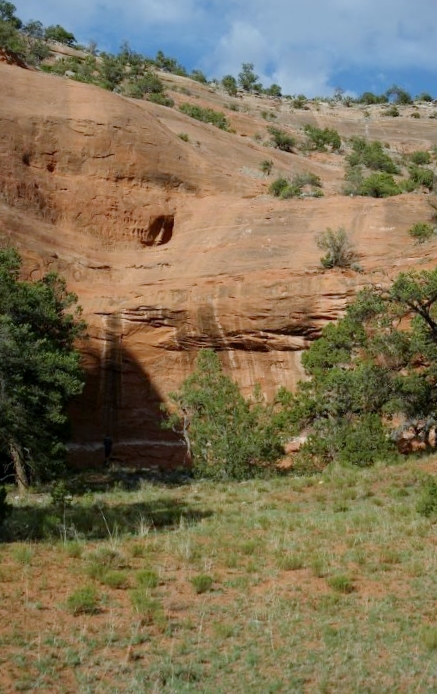
In the Stone Fields

photograph by Sonja Bingen

a love poem to Ethel by Thomas Davis

In the stone fields
The roots of the pinyon
Interweave with stone.
In the barest silence
Song is worn like a cloak
Of the brightest colors.

May my lips be as a brook
Bubbling forth songs
In praise of my love.
May my heart be as a pinyon,
Drawing forth music
From the barest stones.

Originally published in The New Quiver, University of Wisconsin–Oshkosh, copyright 1972.

6 Comments

Filed under Photography, Poetry, Thomas Davis

29. Another Dragon Scale

an epic poem by Thomas Davis

Beside the pond’s white, frozen face, the sound
Of water from the stream beneath the ice
A muffled music in the morning air,
Wei waved her arms and conjured motes
Of fire congealing to a dragon’s shape.
She strained to make the dragon breathe with scales
As golden as Ssruaanne’s great shimmering.
She concentrated, gathering the whole
Of whom she was into the spell she wove.
The motes of light began to coalesce.
The dragon in the air took shape, its eyes
So bright they nearly seemed to be alive.
Wei felt the power in her young girl’s body
Sweep out of her into the dragon’s head,
Its nostrils flaring as she tried to find
A dragon’s breath in dragon lungs beneath
The light she wove into the winter air…

But then, just like the other times, the motes
Of light collapsed into a day’s blue skies.
She held the eyes a moment as they looked
At her, their golden green intelligence,
But even though she danced her hands and wove
Her body as she tried to find the power
That let the spell she’d made exist in time,
The dragon eyes scattered into nothingness.

The irritation that she felt was strong
Enough to make her want to cry, but deep
Inside she knew that if the tears began,
They’d wrack her body, bringing weariness
That would not let her try to form a dragon
From air again for days and maybe weeks.

She shook her head and felt the warmth the sun
Was pouring down onto the fields of snow.
A hint of spring was in the air, although
Real spring was still at least a month away.
Why did she feel as if she had to form
A dragon from the still-fresh memories
Ssruanne had left inside of who she was?
What kind of girl had she become? Her mother’s
Ethereal spirit once alive, now gone?
Her body thin enough so that it seemed
As if a puff of wind could scatter her
Just like the dragons that she tried to make
Evaporated into empty air?

She sighed and turned away from where the sun
Would shine upon the pond’s still face in spring
And walked to where the woodpile stood and took
Two chunks of wood into the cottage-warmth.
She put one piece upon the fire and watched
As flames licked up its sides through rising smoke.
Why had her mother’s ghost not come again?
She asked herself. Where had her mother gone?

She shook her head and picked the rabbit laying
Beside the sink up by its large hind legs.
The trap she’d made from fire had kept her fed
As winter kept its grip upon the land.
Strong spelling had its uses. That was sure.
She took a knife out of the drawer, started
The job of skinning rabbit fur and hide,
And thought about her coming birthday, how
It would not mean what once it would have meant.
She’d get no presents, eat no special meal.
She missed her mother, not the spectral form
That taught her spells out of her mother’s grave—
Her living mother quick to comfort her
And pick her up and make her feel love’s warmth.
She put the knife down, poured some water, washed
Her hands and quietly walked to her bed.
She’d never heard of anyone with power
Enough to make a dragon out of air,
But still, she felt as if she ought to breathe
And work her spells and feel a dragon’s life
Flow from her hands into a living dragon.

She sat down on the bed and looked at where
The dragon’s scale was burned into her arm.
A bunch of other kids would stare at her,
Then scream and run away to see the scale,
She thought. They’d know that she was strange.

She waved her arm above her head and felt
The scale grow warm. She moved both arms and felt
A spell grow in the air, its power stirring
Inside the cottage, stimulating life.
She started humming underneath her breath
And broke into a song that trilled and soared
And made her feel her power once again.
She was a girl, she thought. A girl. A girl.

A square beside the scale she wore began
To burn her flesh; she felt the fire inside
Her arm and felt a second scale begin
To grow beside the first, a dragon’s life
Inside her life, out of her life, a dragon…

She stopped and let her arms fall from the air
And let the silence come back to the room.
She held her arm up, stared at where two scales
Laid side by side, their gold burned in her arm.
She waved her arm and tried to feel if it
Was heavier than it had been before.
It felt as if it was her arm, but looked
As strange as any arm had ever looked.

What kind of girl had she become? she asked.
She felt the movements of the fate
That waited her and felt as strong and fierce
As any dragon born out of an egg.

To listen to this section of the epic, click on Another Dragon Scale

Note: This is the twenty-ninth section of a long narrative poem, which has grown into The Dragon Epic. Inspired by John Keats’ long narrative poem, Lamia, it tells a story set in ancient times when dragons and humans were at peace. Click on the numbers below to reach other sections, or go to the Categories box to the right under The Dragon Epic. Click on 1 to go to the beginning and read forward. Go to Unexpected Warning to go to the section previous to this one. To read the next section of the epic, click on Valley of the Scorched Black Stones

9 Comments

Filed under Poetry, The Dragon Epic, Thomas Davis

A Walrus and an Elephant Discussing The Whale That Runs the General Store

a children’s poem by Thomas Davis

“Well,” said the walrus to the elephant upon the shore.
“Have you heard the news the fish are telling
To the whale that runs the General Store?”

“Yes, I’ve heard,” answered the elephant with an ivory grin.
“I’ve heard the crazy, busy-body fish
Are trying to make the whale think that he is thin!”

6 Comments

Filed under Poetry, Thomas Davis

28. Unexpected Warning

an epic poem, The Dragon Epic, by Thomas Davis

For four whole days Ruanne stayed in her cottage,
Her mind obsessed with understanding how
Ruarther had decided that he’d keep
His vile intent to kill Crayllon’s young child.
When Reestor knocked and called to her, she sat
Inside her rocking chair, her energy
So sapped she could not force herself to move.
When Old Broar came she listened to his voice
And told herself she ought to answer him,
But as she tried to force herself to move,
She lost her will and fled into a place
Where silence made her feel as if she was
A stone, a weight too ponderous to stir.

What’s wrong with me? she thought. How can I sit
When in the wilderness Ruarther stalks
The child, and dragons calculate how fire
Will rain upon the village that I love?
Why can’t I find some energy to act?
To try to talk to dragons, let them know
The humans want to keep the peace alive?

She got up from the chair, her restlessness
So powerful it seemed to make her move.
I need to sleep, she thought. Or maybe die.

The thought of suicide hit like a bolt
Of lightning coursing through her sluggish blood.
She’d been so positive, determined that she’d find
Ruarther, keep him safe, end threats from dragons,
And shield Crayllon’s child from Ruarther’s rage.
She sat down on the bed and longed to end
Insomnia and all the doubts that crowded
Into her head and took away her rationality.
She been awake for days, she thought. For days.

She laid down, closed her eyes, the universe
A journey in the dark toward a place
Immenseness spiraled ever outward, past
The smallness of the woman who she was,
Past consciousness into an emptiness
That seemed to stretch and stretch into forever.

The darkness overwhelmed her, made her feel
Alone, as worthless as a woman lost.
But then she felt a rhythm in the dark.
Hands wove a web into the nothingness.
A woman’s hands, had grabbed a spirit bear
Translating from one world into the next
And forged a passageway, a tiny portal,
Between the purgatory of the dark
And sunlight stretched across great fields of snow.
She felt Ruarther’s rage strike at the bear…

And then she felt a dragon’s curious mind
Invade her like a boiling swarm of bees,
His hugeness startled at the spark she sent
Across the fields into a darkened cave.
Her body shook to feel intelligence
That poked at her as if her insignificance
Was novel, hardly to be countenanced.

Inside the dragon’s thought she forced herself
Away from where she’d been inside her bed
And, sloughing off her lethargy, discovered
The fire of who she was, the woman wild
Enough to set off in the wilderness
To find the only man she’d ever loved.

She felt the dragon staring at her mind.
He did not speak, but stirred out of his thoughts
To see what human was confronting him.
At last he said, “And who are you?” his voice
So loud inside her head it made her tremble.

She looked into his eyes inside his cave
And wondered how she saw across the miles.
She could not think. His hugeness was too large.
He waited, looking patiently at her.
She felt a panic rising up into her throat.
“Who are you?” she demanded, wondering
At how she’d found the bravery to speak.

The dragon blinked. “I’m Mmirrimann,” he said.
“I ask again: And who are you that’s brave
Enough to face a dragon in his lair?”

His words unnerved Ruanne. Mmirrimann?
The leader dragon who had made the peace?
The murderer of Reestor’s father ? Legend
That spoke to her as if she was alive?

“The humans do not want a war,” she said,
The mission given her by Reestor flooding
Into her head. “Our children need to live.”

The dragon blinked again. Inside his eyes
So alien to human eyes Ruanne believed
She felt a sadness powerful beyond
The human sadness that had troubled her.

“I too would like to keep the peace,” he said.
“But I am old, and younger males see war
As part of who a dragon ought to be.
You’d better let your leaders know my words.
I cannot stop the war to come though I
Would give up all my years to see the peace
Stretch out into an endless march of time.
War’s near, and though I’ll try to keep its rage
From ending dragon life, I’ve searched, but found
No way to stop the conflagration’s fires.”

He looked away. The emptiness returned.
Ruanne stared at her hands clutched in her lap.
The greatest dragon that had ever lived
Could find no way to stop the war Ruarther
In madness had engendered from his rage?

Someone was pounding at her cottage door.
“Ruanne? Ruanne?” a worried Reestor called.
“You can’t hide from the world, Ruanne,” he said.

Ruanne remembered sadness in the eyes
That stared so powerfully into her eyes.
She got up, went to open up the door.

To listen to this section of the epic, click on Unexpected Warning

Note: This is the twenty-eighth section of a long narrative poem, which has grown into The Dragon Epic. Inspired by John Keats’ long narrative poem, Lamia, it tells a story set in ancient times when dragons and humans were at peace. Click on the numbers below to reach other sections, or go to the Categories box to the right under The Dragon Epic. Click on 1 to go to the beginning and read forward. Go to Conversation From Love Through Fear to go to the section previous to this one. To read the next section of the epic, click on Another Dragon Scale.

6 Comments

Filed under Poetry, The Dragon Epic, Thomas Davis

Of Love

by Thomas Davis

The round, close face,
Soft like gentle hills
And as misty as the sky
Full of coming rain,
Inspires this song—

The beauty beyond thought
And love beyond the beauty.

9 Comments

Filed under Poetry, Thomas Davis