Category Archives: Poetry

Uncover My Eyes

by Thomas Davis

Uncover my eyes that I may look
And see the mountains covered with shadow,
The tambourine of stars in the sky,
The trumpet of the new moon!

Uncover my eyes that I may look
And see the rain cloud tent over the earth,
The rain slant like small grey spears into the earth,
The small rivers flowing away from flinty rock!

Uncover my eyes that I may look
And see her dancing to the melodious sound of the harp,
Her feet moving like the wind-blown blossoms of cherry trees,
Her hands clapping in time to the movement of stars!

Note: This is a love poem I wrote to Ethel when we were both young. These and the children’s poems I am posting were written in the 1960s and 1970s. Reading these, I find I have lost the young poet’s lyricism. But I still love Ethel. A lifetime love is still possible.

16 Comments

Filed under Poetry, Thomas Davis

Reflections of a Country Girl for her Mother

by Ethel Mortenson Davis

Once, when the creek
had swelled its banks in spring,
and I had run to meet its new boundaries
to build a raft again
that could carry me down the Little Sandy
toward lands unknown,
I was sidetracked by a patch
of blue and yellow violets—
too many to let go unnoticed,
found among the wet and shady places—
and I forgot about the countries unseen.

And in fist-fulls I came running,
sharing them with you—
and you received them well,
arranging them in glass jars,
teaching me to love
the spring beauties and things:
The funny-faced Holstein calves
and the timid chickadees
who came in December
to snatch your winter’s crumbs.

© 2011 White Ermine Across Her Shoulders

13 Comments

Filed under Ethel Mortenson Davis, Poetry

16. Separation in the Wilderness

an epic poem by Thomas Davis

His stupefaction, as he sat in snow
Beside the boulder as his pain seared skin,
Kept him from seeing Cragdon packing up
To struggle back the way they’d come across
The treachery of fields of blinding snow.

“I’m leaving now,” the young man said, his face
A mask of pain where dragon’s fire had burned
His arm and side. “I’m done. I’m going home.”

Ruarther, from his seat, looked up and stared
Into the young man’s bleary-looking eyes.

“You’ve lost your mind,” he said. “We’re injured bad.
Until we’ve got our hurts controlled, the village
Is just a dream you’ll never reach alive.”

The pre-dawn cold was hinting at the light
Now filtering along the eastern ridges.

“I knew I’d have to go alone,” the young man said.
“You’re crazy. Why I followed you out here
Is something that I’ll never understand.”

“The witch’s child has stirred the dragons up,”
Ruarther growled. “You’re suffering from burns
Inflicted by a dragon hurtling
From skies without a reason made by us.”

“Perhaps it read our minds and gave us warning
That murdering a child is not the way
To keep the human, dragon peace,” he said.
“I’ll send the hunters out with fresh supplies.
You’ll have to keep alive until you’re found.”

Ruarther looked inside the raging self
That seemed to boil with pain and anger branded
So deep it was the substance of his life.
He growled again, but did not say a word.

As Cragdon looked at him, the man he’d seen
As better than a man could ever be,
His hero since he’d been a child who’d hung
Upon the village’s stone wall to watch
For hunters coming from the woods, their game
On tripods made of fresh-cut branches roped
Around their hips, or slung on massive shoulders,
And wondered why he’d failed to see the truth.
The grim, dark man who leaned against the boulder
Was not a village man, but bound
To raving spirit beasts whose sentience
Danced chaos born from rage into the world.
He shook his head and looked toward the slopes
That angled down toward the only place
He really cared about inside the world.

“I’m going now,” he said. The snow shined brightly
As sunrise danced with sky fire as it crept
Across the treacherous, white miles of crust.
He wondered if he had the strength to make
It to his wife and child, the life he loved.
He briefly wondered where the dragon was.
It too was facing weeks of burning pain.
He shook his head, then moved out from the ridge.

Ruarther failed to hear, or see, when Cragdon
Began his journey home. He fought to block
His pain from consciousness and tried to focus
Upon the task of finding peace again
By murdering the witch’s child and letting dragons
Go back to living in their caves away
From hunters and their villages and homes.
He tried to see the child’s unnatural eyes
And wondered how a witch with minor skills
Could birth a witch so powerful her strings
Turned dragons into puppets of her will.

He felt the golden dragon’s whirling eyes
Confront him, heard the power in her voice,
But when he looked around to see her body,
The wilderness and sky were empty, vast
Beyond imagination, fevers wrapped
Around him like a fire inside his flesh.
He cupped snow in his hands and spread its cold
Upon his burns and coughed deep in his lungs.
He wondered if he’d be alive when dawn
Lit up the sky again and wheeled another day.

But then he knew: He’d kill the witch’s child.
He’d give Ruanne the peace his love deserved.
He’d let the dragons settle back into their lives.

He forced himself onto his feet and put
More wood to burn upon the dying fire.

Click to hear an audio of this section: Separation in the Wilderness

Note: This is the sixteenth installment of a long narrative poem. Inspired by John Keats’ long narrative poem, Lamia, it tells a story set in ancient times when dragons and humans were at peace. Click on the numbers below to reach other sections, or go to the Categories box to the right under The Dragon Epic. Click on 1 to go to the beginning and read forward. Go to 15 to read the installment before this one. Click on 17 to go to the next installment.

8 Comments

Filed under Poetry, The Dragon Epic, Thomas Davis

Presence

by Ethel Mortenson Davis

She had missed
the elk and rabbit
this morning.

She didn’t see
the grasses parted
where a trail
was apparent,
where rabbit brush
was trampled down
from the great bodies of elk.

But they watched her
as she walked by.

She unaware,
this morning,
of their presence.

© 2010 I Sleep Between the Moons of New Mexico

9 Comments

Filed under Ethel Mortenson Davis, Poetry

The Old Gray Wife

by Thomas Davis

I’ve never met a woman
Who looked so tired and worn
As that old earthy lady
Of the early morn.

She wears gray skirts and blouses
Soaked wet by morning dew
And goes around a dyeing
The skies a laundry blue.

I’ve heard that her bright husband
Is such a sleepyhead
She has to light his fire
To get him out of bed.

Note: Since posting the last of the sonnet sequence, I have been wondering what to post next. Writing the dragon epic is taking up the little writing time I have, but I am only able to write one section a week. The problem is that Ethel and I each post two poems a week. Betty Hayes Albright, who posts wonderful children’s poetry, recently asked if I would post children’s poetry I wrote for my two daughters, Sonja Bingen and Mary Wood, when they were young. I am not sure they will remember the poems, but that is one answer to my dilemma. Another is that I could publish love poems I wrote to Ethel when we were young. I have decided to publish both children’s and love poems over the next few months as I finish the dragon epic. Most were written in the 1960s and 1970s, although I am still writing love poems to Ethel all these years later.

14 Comments

Filed under Poetry, Thomas Davis

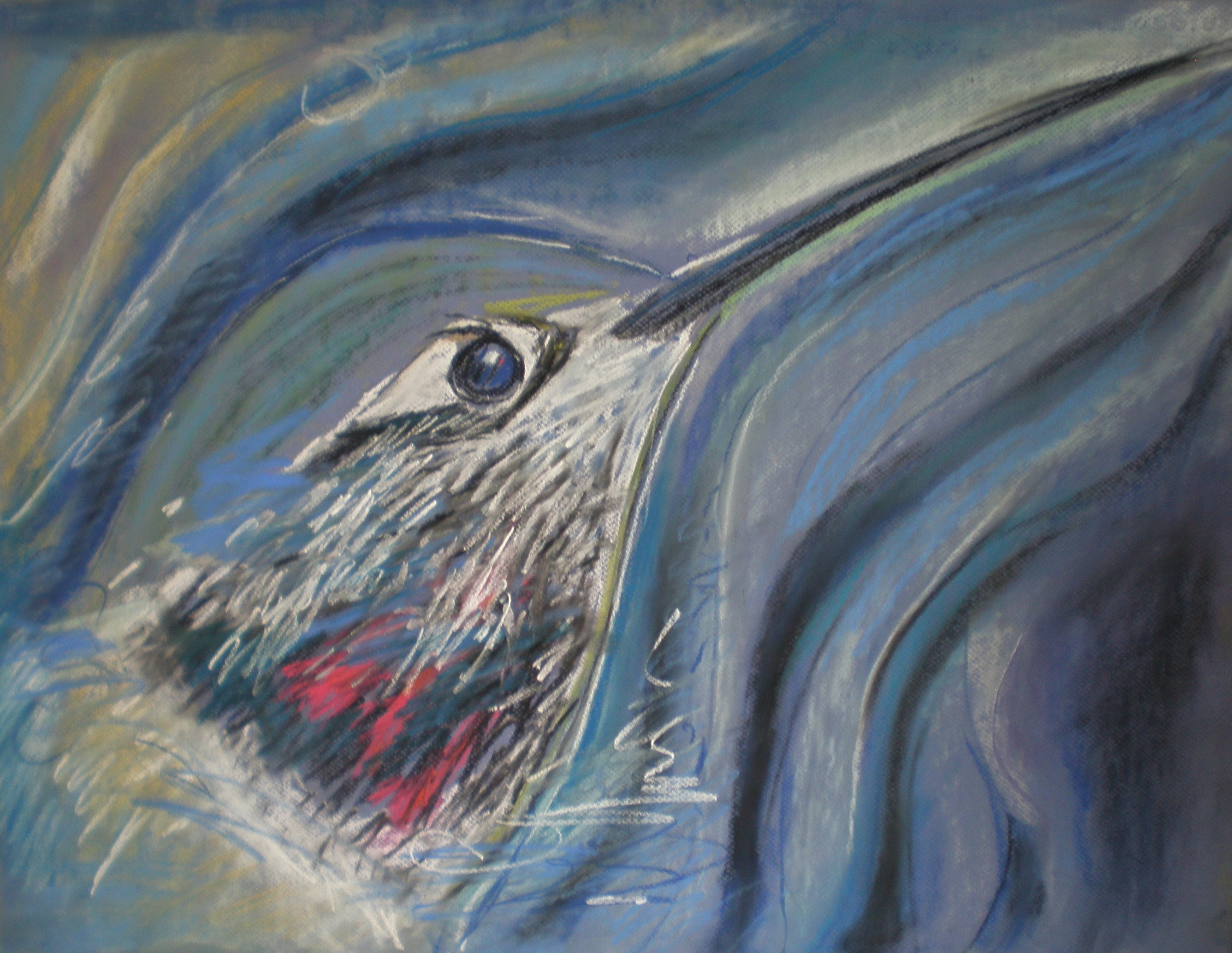
Calliope Hummingbird and Circles

a pastel and poem by Ethel Mortenson Davis

Circles

When I drive
through the desert,
I keep the windows rolled down
and usually hear a few notes
from the meadow lark.
New Mexico is full of bird life.

This morning, after last night’s shower,
I heard the clicks
of the Rufus hummingbird
through my car’s open window-
a metallic pinging sound-
like electric highline wires make
when you stand under them.

The hummingbird kisses
the delicate circuits
of the eco-systems.

In the north
the snowmobiles run
the gray wolf to exhaustion.
Once the gray wolf
was chased with dog sleds
or snow-shoes
and had a chance
to escape.

The wolf bites at his body
where the bullet enters,
shattering his flesh and bone,
shattering the delicate circles of life.

9 Comments

Filed under Art, Ethel Mortenson Davis, Poetry

15. Ending Dragon Community

an epic poem by Thomas Davis

Inside the conclave’s cavern elders sat
Upon the great, stone ledge, their eyes so bright
The darkness near them whorled with colored lights.
Ssruanne, her spirit broken by the chaos
Of dragons violating rules set down
To let community replace the greed
And singularity of dragonkind,
Joined song with Mmirimann as elders strove
To calm the storm as dragons fled from caves
Into the bitter cold of winter skies.

Wwilliama, feeling that her words had caused
The chaos when she’d let her fear of humans
Subdue her sentience, worked hard to meld
Her spirit’s song to all the others’ songs,
The elder’s unity the sanity
That could undo the madness firing hearts
With ancient hate and rage, the skies alive
With vengeance borne on frantic dragon wings.

At last they found Sshruunak’s black rage, the fear
Inside his hearts so dark it made him blind
To everything he’d learned of dragon lore.
They felt him hurtling toward two humans
Beside a fire that burned against the cold.
Ssruanne sent songs of peace and calm through skies
To where his fierce-some rage was uncontrolled.
The elder song inside the cavern rose
Into a symphony of power filled
With whirling eyes and hearts that tried to mend
The great black dragon’s rage and mindless fear.
The cavern echoed with the voices drawn
From dragon chests and massive vocal chords.

They felt the violation of the truce
Made with the human Clayton, King of Tryon.
They felt an arrow burn into Shruunak’s dark eye
And felt the burning agony of human skin
Seared by the fire of dragon breath and rage.
Their song intensified, past who they were.
Sshruunak turned, hurtled at the humans’ stone shield
Until the hunter jumped from hiding:
Another arrow, burning agony.
Flames wrapped the hunter in its searing shroud,
His pain, Sshruunak’s pain echoing a war
Into the cavern counterpoint to what
The elders had been sending out through skies.

The elders’ wings flared out and made a wind
Inside the cavern sweeping out through tunnels
Into the caves where dragons, not yet stained
By fear, confusion, rage, were pacing, troubled
By what had changed their lives so suddenly.
The males, spread out along the mountains’ slopes,
Sensed pain enveloping Sshruunak, felt wind
Inside the tunnels and the safe, dark caves.
Sshruunak fled humans and their deadly arrows;
The concave elders strove to turn to order,
To end the stirring of a world enraged.

“The peace is done,” said Mmirrimann. “The dragons
And humans know the taste of blood again.”

His words destroyed the elders’ song and plunged
The cavern deep in dark intense enough
To spread across the winter of the earth.

Ssruanne slumped on the eldest dais.
Inside the darkness of her spirit, small,
She felt the witch’s child and saw her hands
Create a golden dragon’s scale and burn
It into flesh, transforming human flesh.

Before the peace all dragonkind had faced
Eventual decline into extinction.
The young males thought that dragonkind could win
Against the tides of human machinations.
They knew their strength and did not understand
That war was more than strength or dragon will.
Shruunak had breached the truce, and now? She shuddered.

“What now?” she asked as Mmirimann stared blankly
At cavern darkness. “Wisdom still exists.”

“The witch’s child is dead,” the dragon mourned.
“I felt your vision, saw the withering
If rage was loosed into the world again.
Shruunak’s a hero now inside the caves.
He’ll want revenge against the girl, her death.”

Wwilliama said, “This will not be. I caused
This madness with a mindless stream of words.
The males will listen. If I see my madness,
They’ve got capacity to see their madness too.”

The geas came on Ssruanne and made her cry,
“The girl is still alive! She’ll stay alive!
I’ll use my dragon life to find the peace!”

Old Mmirrimann looked at his ancient lover,
Then slowly dragged himself into the dark.

Click to hear an audio of this section: Ending Dragon Community2

Note: This is the fifteenth installment of a long poem. Inspired by John Keats’ long narrative poem, Lamia, it tells a story set in ancient times when dragons and humans were at peace. Click on the numbers below to reach other sections, or go to the Categories box to the right under The Dragon Epic. Click on 1 to go to the beginning and read forward. Go to 14 to read the section before this one. Go to 16 to read the next section.

10 Comments

Filed under Poetry, The Dragon Epic, Thomas Davis

Stone Child

by Ethel Mortenson Davis

Where were you
when they took her
from me?

Stone Child,
I will give you
lips to speak with.

Where were you
When they tortured
And killed her?

Stone Child,
I will give you
eyes to see with.

Where were you
when they threw her
out on the desert?

Stone Child,
I will give you
ears to hear with.

Where were you?

Stone Child,
I will give you
wings to leave this world.

12 Comments

Filed under Ethel Mortenson Davis, Poetry

Sonnet 45

by Thomas Davis

I name them: Sophie, Phoebe, William, Joe,
each one of them as individual
as early mornings in New Mexico
when shining light holds trees and land in thrall.
Joe, lost in circles only he can see,
and William, king of Legos, friend of friends,
Sweet Phoebe, bright as any sun, a sea
of light that’s always looking past the bend,
and Sophie, fledgling eagle nearing flight—
like William, first born, disciplined, and kind.

We’ve lost our son, and in our grief the blight
of memories assaults our days and minds,

but in our hearts grandchildren laugh and sing
and help us think we’ll know another Spring.

This is the last sonnet in the sonnet sequence I have been posting for the last several months. Kevin’s life (February 16, 1982 – July 23, 2010) was shortened by an unknown cancer that we only knew about for a few short weeks in June and July of 2010. Ethel and I traveled to Poughkeesie, New York to be with him during his last several weeks and was there during days of excruciating pain and small triumphs that ended in deep grief. The sonnets were mostly written as our beloved son lay dying as day passed day, and time’s march brought us, finally, to his death. They were written as my way of trying to deal with an impossible, unbelievable, unacceptable time. The last sonnets in the sequence were written after Ethel and I had returned to New Mexico.

Ethel has written extensively about this time too. The last poem she posted on fourwindowspress, “In the Night,” was written in a cancer ward hospital room. Some of her poetry foresaw the nightmare to come; other poems were written during Kevin’s illness. A few were written in the year and a half since we came home.

I hesitated to put these sonnets out for the wordpress world to see. Should you publish anything so raw and filled with horror and grief? In the end I am grateful I went ahead and started posting them. I am incredibly busy as Dean of Instruction at Navajo Technical College, all of us have responsibilities to our families, and wordpress can devour time, so I seldom answer the many many comments put on our blog. I have this need to try to say something meaningful, and that takes time, and if I spent that time responding to comments I would have no time to read other poets. That would make my life poorer. But the truth is that comments placed with love beneath each sonnet has been deeply moving. They have helped Ethel and I keep on keeping on, and though some days you wonder why we humans keep doing that, the answer is contained in words and voices that connect us to one another.

When this sonnet was written in August of 2010, I could tell the impulse to write sonnets about the sequence of events and emotions accompanying Kevin’s illness and death was waning as the inexorable demands of living kept dragging me through my days. When I sat down one evening and wrote it, I knew this was the last of the sequence, the reason, in the face of all our tragedies, we keep walking this good earth. A human life is not forever. We see sunlight for a day and laugh without realizing the joy we are experiencing, and then cancer or some other illness enters our lives, and we face the boundary we cannot see past. At that moment we have so little left. Pride and dreams of the future that have ticked out the clock of our lives mean less than they did before. Yet, the voices of those who have loved us and whom we have loved sound deep inside our humanity and become life’s reason, the meaning for who we have been and who we are at this moment.

I have been battling bladder cancer since it revealed itself this winter. My prognosis is positive, unlike Kevin’s, but this is a sobering time. Not only have we been with our son as he died, but my own mortality is as raw in my face as his mortality was as he slipped into a coma from which he never awoke. At such moments you worry incessantly about the closest people to you. You also wonder if you have left any legacy at all. You want to make sure the lives you have so deeply cared for are going to experience laughter that denotes joy they do not realize they are experiencing. Have you done enough? Has your life been honorable through your days? And you think about your father, who is gone, and mother, who still goes at the word, go; the love of your life; your now gone son; your wonderful daughters, and your grandchildren cusped on making themselves who they will become.

And inside your worry the New Mexico sun shines with the high desert’s magic, God’s magic, blackbirds sing liquid songs, you wake in the morning with your wife of 44 glorious years beside you, you know that you will talk on the phone to your daughters before sunset, and you hear your grandchildren in your head dancing through their prom night or chasing a kite bobbing high in a springtime sky, and you know that life is more precious than you have known and that when it is all over, you will know, in those last moment, that you have been loved and have loved. What else matters? What else truly means at the end of a long, glorious day?

24 Comments

Filed under Essays, Poetry, Thomas Davis

In the Night

by Ethel Mortenson Davis

I wanted to gather you
up in my arms,
like a mother
gathers her young,
and bring you back
to New Mexico—
a place you once loved.

I wanted to take
you away
from the suffocating people
in that room
so I could listen,
alone,
to your ragged
breathing.

A gift
in the night.

© copyright 2011 White Ermine Across Her Shoulders

13 Comments

Filed under Ethel Mortenson Davis, Poetry