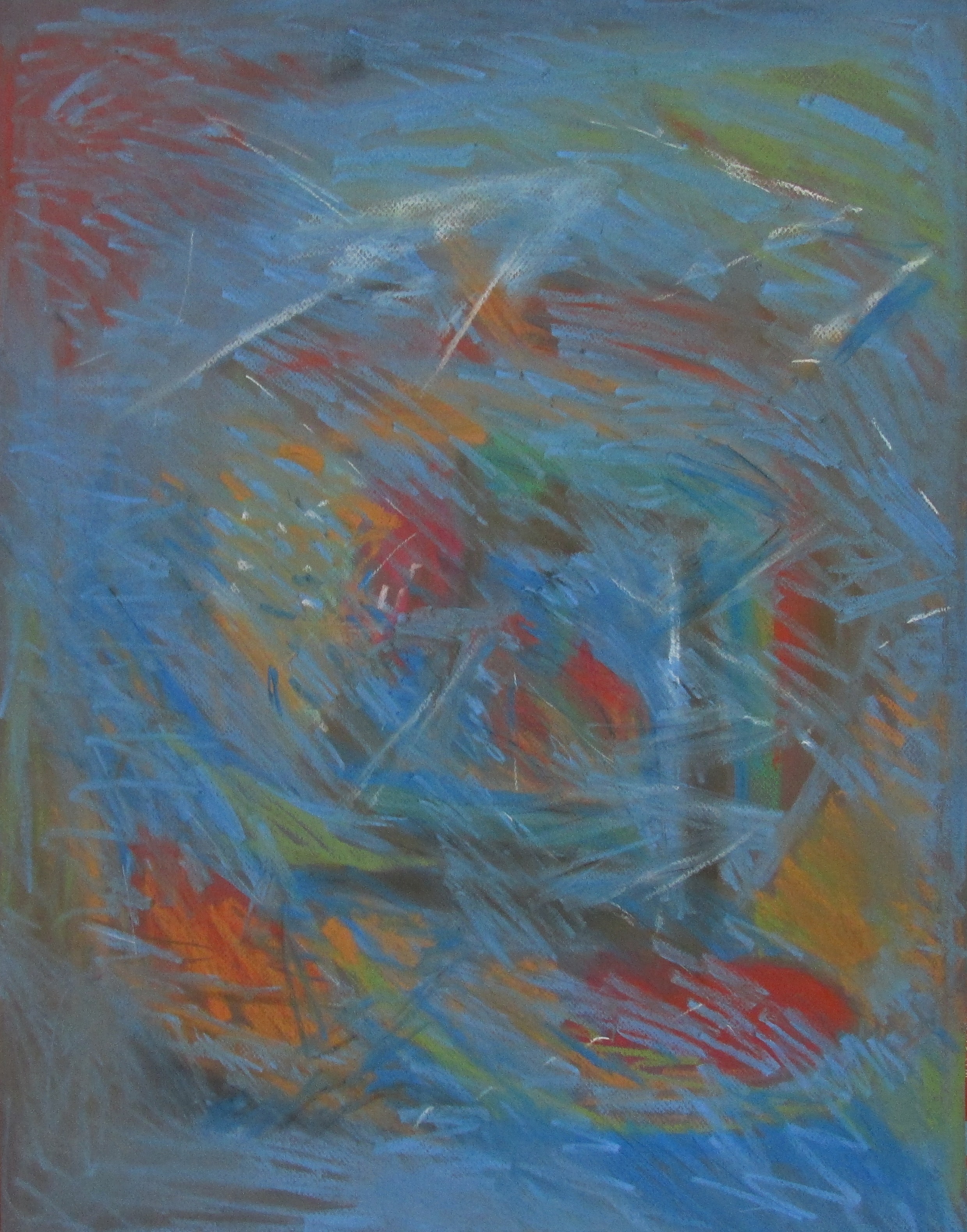
a photograph by Sonja Bingen
Encounter With A Gray Morph Owl
by Thomas Davis
He saw the gray morph owl, its yellow eyes
A spectre deep in darkness, as he climbed
The ridge where birch trees ghosted, bent as skies
Shrieked cold and lake waves slammed against black stones.
Its whitish face, curved bill, and pointed ears
Leapt out at him the moment that he seized
The steep-slope sapling. Senseless, ancient fears
Gasped through his veins and, beating, spiked his heart.
Inside its cedar trunk, the owl, three times,
Sang, startled at his human face, and spread
Its wings as if it had the strength to climb
Past dread into a hunter’s surety.
He wondered at the madness that had forced
Him out into the storm, his restlessness
So powerful it stirred his sleep and coursed
Through legs that moved him out the door.
Ghost feathers touched his face and spooked the song
Wrung from the owl into his blood as whiteness
Whipped wildly out of sight in wind along
The ridge’s denseness edged against the sky.
He stood, knee deep in snow, the slope so steep
He hardly had the strength to stay upright
And longed to feel the warmth of lovely sleep
Out of the bitter cold beneath the snow.
The roaring waves, the wildness of the night,
Knifed down past flesh to marrow in his bones.
He turned and trudged toward the kitchen light
That meant a fire and shelter from the storm.
Back home, beside the fireplace, darkness seared
Into his thoughts, he took his pocketknife
And started whittling the way an owl’s eyes sheered
The wildness from the spirit of a man.
Filed under Poetry, Thomas Davis
Shades of Geese Dredged Out of Time
by Thomas Davis
The old man walks into the cedar forest.
Cold waves rise up to thunder white-capped rage
Against dark dolostone cloaked white with snow.
The twisted trunks of trees, born in an age
Long past, reach out into the old man’s path
And clutch at bearskin boots as black as night.
Time whorls as lightning jags above the slate
Of waves, and thunder dances cloudy light
Into a rush of wilding, whistling wind.
The old man stands upon a cold, high ledge
Inside the wierding winter of the storm
And stares at ice congealed from clouds of mist
That glitter as a shining spray transforms
The frigid air into a swirl of light
Reflecting darkness from the dolostone.
The old man sighs, and in an ancient voice
Begins to sing, his voice a toneless drone.
Out of the icing mist a flock of geese
Fly, wings a whir, from cresting, foaming waves.
Behind them shades of geese, dredged out of time,
Come streaming from the darkness of the caves
Beneath the old man’s ledge shined black with ice.
The old man lifts his arms and tries to see,
Inside the mist of time, what fate is threaded
Into the heartbeats of humanity.
The cedar forest snakes its roots through stone.
The storm’s crescendo rises as the lightning
Disperses fire above the raging waves.
Snow whips through wind, a hail-hard stinging
That bites through deerskin clothes into cold flesh
And brings cold tears into the old man’s eyes.
Tears freeze; the geese shades disappear; the man
Stands blind beneath the fury of the skies.
Filed under Poetry, Thomas Davis
Guess the Building?
Filed under Art, Photography
Ancestors
by Ethel Mortenson Davis
All my ancestors
live inside of me.
One Grandfather cut down
the biggest tree in the county.
My Mother said,
“Why didn’t he leave
the biggest tree
to grow even bigger?”
Another Grandfather
referred to his trees
as “He and She.”
“Save those orange seeds;
they will grow into trees.”
One Grandmother said,
“What will they serve
for the wedding feast?
Rabbit?”
My room is filled
to the rafters
with their voices.
Every once in awhile
some ancestor
will sneak up behind me
and rudely nudge me
in the back
when I’m least
expecting it.
Filed under Ethel Mortenson Davis, Poetry
The Power Wagon Chugged Like a Snuffling Bear
by Thomas Davis
Wheels churned down through snow layers
until they reached hard ground,
and then the dark green cab and truck bed jumped
forward, stopping and lurching as it slowly made
its way across cactus flats toward a hill nestled below
a higher hill where aspen provided a place
where we could pitch tents and build a campfire.
There were two of us, Howard Johnson,
a tall, raw boned kid whose uncle, Jeff Burns,
was the government trapper,
a man who caught mountain lions for delivery to zoos,
and I, more bookworm than mountain man.
Howard had decided to go hunting in Snyder Flats,
and I’d eagerly gone along, excited to feel the bite
of winds that could carve drifts six feet high
when snow mostly-covered sagebrush on flats empty of trees.
When the power wagon finally climbed the hill
the aspen grove was dark with evening shadows.
By the time we had tents pitched and a fire going
the moon was waxing full with a silver silence
echoed from the universe’s blanket of stars.
By the time we crawled into down sleeping bags
neither of us had said a word to each other for hours.
We woke before dawn when first light smudges
dirtied hill horizons east of where we were.
Howard was in a good mood, starting the fire with twigs,
joking about how crazy we had to be
fixing frozen slabs of bacon and bread over a campfire
when we could have been crawling out of bed
in a house filled with civilization’s conveniences.
A half hour later, bellies full, fighting cold’s numbness,
we were climbing the hill behind our campsite,
fighting through snow that sometimes came up to our waists.
Howard was stronger and broke trail,
but my breath was sharp as I struggled through a morning
so cold air felt like shards of shattered crystal.
At the hill’s top we walked out on rimrock towered above a canyon.
Below us drifts danced with swells in a landscape frozen into waves.
We stopped and felt wilderness’s immenseness.
“Think we’ll see any deer?” I asked. Howard snorted.
“This is Snyder Flats,” he said. “We might even see a grizzly.”
I nodded, then we set out again, keeping close to the canyon rim,
fighting the sun’s glare off glittering snow.
Hours passed. Even Howard was getting tired and irritable.
Not even a jack rabbit exploded from cover.
Noon came and went; the sun blazed orange, yellow, and red
over the western horizon. Cold became more and more intense.
By the time we found our camp again stars were out
and our feet and hands were numb from a breeze
sweeping across flats up into the hills.
The next day was like the first day. We walked and walked,
but if life was in the universe, it was hiding.
We had told our parents we would be gone four days,
and we’d have to spend most of the fourth day
lurching our way down the hill, through the flats to the dirt road
that would lead us back to Grand Junction and home.
Neither my Dad nor Jess Burns had approved of going to Snyder Flats,
so if we were late they would come looking for us,
and when they found us we’d both have to face wrath
that would resolve itself into chores best avoided.
As daylight began to wane we knew we were too far from camp.
We’d plowed through snow with a ferocity that burned lungs
and made even Howard complain about how tired he was.
By the time we gave up hunting and faced the fact
that our grand trip to Snyder Flats was an unredeemable bust,
we were miles from camp, half lost, and on the other side of the canyon
behind the hill that sheltered the hill with our supplies.
As the full moon came up, discouraged, half scared,
we were trying not to fall as we felt our way down the cliff’s face.
I had just managed to use cracks to climb down ten feet of sheer rock
to stand on solid ground when Howard grabbed my arm.
“Tommy,” he whispered.
His voice had an urgency that made my heart thump in my ears.
I looked toward where he was pointing.
Not forty feet away an immense grizzly was shambling
toward where we were standing.
Howard seemed frozen. We both had guns,
but the bear seemed to be the size of two bears.
The moon was so bright you could make out its hump
as it moved toward us, head low to the ground.
What in the hell have I got myself into now? I asked myself silently.
My stomach churned. Queasy. Unstable.
Howard stared at the bear mesmerized.
God let this be all right, I said to myself. Let this be all right.
Howard slowly began to bring his 30.06 to his shoulder.
The bear saw his movement, turned its massive head toward us
and stood on its hind legs
as if making sure it was seeing what it was seeing.
“Holy Jesus,” Howard said out loud.
No sound. Only moonlight making night almost as bright as day.
Howard seemed to have forgotten about his gun.
The bear didn’t move, but kept staring at us.
It was too dark to see its eyes, but we could feel its eyes anyway,
black, red around the edges, intense with anger at humans
and all humans had done to him and his kind.
A movement caught the edges of my eye,
and I glanced from the grizzly to the south.
“Howard,” I said.
Howard tried to look at the bear and where I was pointing at the same time.
A huge buck was standing in a clearing ten feet from us.
His massive rack seemed to have a hundred points
sprouting in all directions from where horns grew from his head.
I looked back at the towering grizzly.
It was looking away from us toward the buck.
The buck snorted. The grizzly snorted.
Howard and I stood like ice statues in the bitter cold.
“A cactus buck,” Howard said, wonder his voice.
The bear whoofed as it fell to four legs.
With a speed that seemed impossible it blurred toward the buck.
The buck leaped backward, seeming to turn in mid-air.
It bounded down the canyon, outpacing the grizzly.
Within seconds the canyon felt empty again.
Neither Howard nor I spoke as we stood in moonlight
looking toward where the grizzly had gone after the buck.
“Damned cold out here,” Howard said at last.
“Yeah,” I breathed. My legs felt wobbly.
“We’d better get moving,” Howard said.
On the cliff rim, looking down into the canyon, a mile from camp,
cold getting colder and colder, Howard shook his head.
“They’ll never believe this happened if we tell them,” he said.
“No,” I answered. “I don’t think I believe it happened.”
My stomach was still churning queasily.
We turned and plowed toward the power wagon,
tents flimsy against wilderness, and home.
Filed under Poetry, Thomas Davis