Tag Archives: Ethel Mortenson Davis

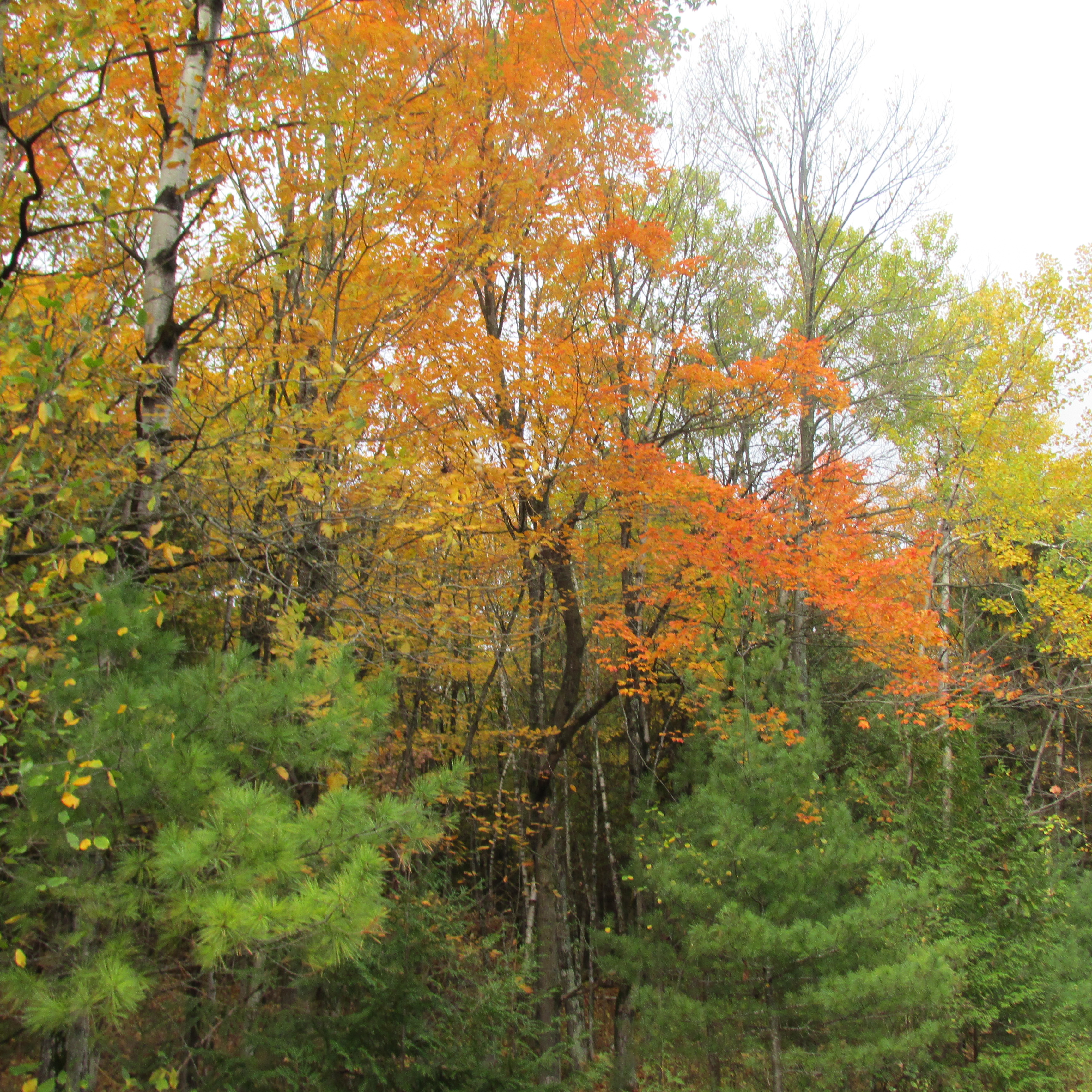
Fall Colors in Potowatomi 2025

Photos by Ethel Mortenson Davis

Leave a comment

Filed under Ethel Mortenson Davis, Photography, Uncategorized

James Janko Review Ethel Mortenson Davis’s Newest Book, The Woman and the Whale

James Janko is one of the most significant authors in the United States. His newest novel, Wired, is on pre-order now. I’ve ordered it. When he wrote to me telling me that he thought Ethel was one of the most important poets in the world, he directed me to a review he’d written about her latest book of Poetry, The Woman and the Whale. I couldn’t agree with him more. I think a superb writer recognizes superb writing and is a wonderful judge of what he reads.

1 Comment

Filed under Essays, Ethel Mortenson Davis, poems, Poetry

The Metaphors in “The Healing Journey” by Ethel Mortenson Davis

Thomas Davis

I don’t know that I have ever written anything about one of Ethel’s poems. She’s my wife, after all, and my love for her is as deep as it was the day we were married over 57 years ago, but I thought I’d write on the Easter at least a note about this particular poem. It’s not the only poem she’s written that deserves an essay, of course. You could write a book on the poems that are meaningful and/or powerful enough to deserve commentary.

“Healing Journey” is about a particular place, at least on the surface. Ethel was raised on a dairy farm not too far from Wausau, Wisconsin, and near her parent’s farm is a park called Eau Claire Dells. It’s a beautiful place with black stone, waterfalls, a small canyon, and the deep woods of Wisconsin’s northern mixed hardwood conifer forest. Large maples, basswood, and other hardwood trees are mixed with a scattering of conifers.

The poem starts out with a rich description of the Eau Claire Dells, “the glacial forest” on a warm and humid day. The poet is climbing the high trail that leads to a bridge that spans the highest part of the small canyon that has a river in its depths, “black granite waters.” As daylight fades, “the moss-covered boulders looked like giants strewn/by some ancient glacier eons ago.” At this point, the poem takes on its metamorphic character. Time suddenly encompasses the ancient world as well as the present-day world. In the present, “the cold air rose around my legs” and “Water trickled down everywhere — through the moss carpet/thick with the red mushroom.”

The strong, specific nature of image are characteristic of all Ethel’s poetry, of course. The sense of water in the river and trickling “down everywhere” gives us a feeling of richness, of a different place where time is stretched out while still being as fluid as water, as the “everywhere” notion that is so powerful in this particular stanza. Time becomes a landscape, preparing us for the mysticism that is at the heart of what is to follow..

What is to follow is encompassed in “I had come here before, hoping to resolve a riddle,/but now I had a disease within my body and needed help.” The poet is not well, and the disease she has is troubling her, is a riddle she feels like she must solve. She needs help.

After this line the poet comes to a bridge over the canyon. The metaphors are obvious here. There are dark waters below as they run through dark granite. A bridge takes from one side to another. A canyon in a lot of Ethel’s poetry is a symbol that has to do with a depth that must be crossed. Granite is an age-old symbol of permanence, of rock the wears away only slowly over the ages, so the poet has come to a transition over the darkness of the deep (of death? Of the darkness in the world?) while she is ill, looking to cross over from all she is experiencing.

In these troubled times, it is not difficult to see the poet as a symbol for all humanity, ill, facing a chasm where dark waters are rushing over the dark river that is always next to its journey or below its passage.

The description of the bridge, “. . .black and strong,/made with spaces between the floor planks wide enough/to see the great height at which I was,” allowing the poet to see the river as “a black granite ribbon glistening in the dim light,” is a comforting image. The bridge is strong even if it’s boards are spaced wide apart and won’t collapse if the poet steps from the path she is in on to brave the crossing she intends to make.

Then she sees across the bridge in a clearing in the forest, the wilderness, “a large crowd of people./Their faces were as warm as their hands.” The symbol of hands is interesting here. A hand is also a bridge between human beings. We reach out our hand to help someone that needs that reaching out. In this cases the crowd of faces is also reaching out as the poet crosses the bridge, the chasm, and the dark river.

Then another character enters into the poem. There is no transition here. The nightingale doesn’t appear in anyway. Instead, it whispers: These are people that have helped you/In some way throughout your life.” In classic literature the nightingale is symbolic of beauty, love, and melancholy. It’s known for its beautiful song, which has been linked to spring, mourning, and love throughout history. In the contemporary world it often represents the muse or, sometimes, spiritual purity. I suspect Ethel is using the metaphor to represent the muse inside her without losing the older use of beauty, love, and melancholy. Crossing the chasm and the dark river is not celebratory. It is a spiritual journey that has a sense of purity inside it.

After seeing the people who have helped her during her life, day turns to night, but this is not the night of the dark waters in the river below the chasm. She turns around and crosses the bridge, and “the moon was beginning to shine on the water,” but not only in the water, but also in the poet. She has crossed the bridge and now is crossing it again, changed, especially in her spirit, in a significant way.

In that crossing, the poet “felt as if the sun was beginning to rise.” The dark waters and the chasm still exist, but as in the lines of “Bridge Over Troubled Water” by Simon and Garfunkel, crossing the bridge has eased her mind–as well as her spirit.

“Healing Journey” is a quintessential Easter poem. Many people reading Ethel’s poems see only the surface created by the powerful, often beautiful, images she evokes. However, like most great poets that deserve a wide audience, there’s often more than one way to read her poems. In a recent review of her latest book, The Woman and the Whale, Estella Lauter, the poet and critic, said that many of her poems are metaphors, and there is truth in that statement.

The resurrection from the fear/anxiety of illness, whether it is in a single human being or humankind as whole, to the spiritual purity in experiencing the whisper of the nightingale (whether it is a muse or spirituality–and what is the difference between these?), sings into any reader who looks this deeply into this poem.

4 Comments

Filed under Essays, Ethel Mortenson Davis, Poetry, Thomas Davis

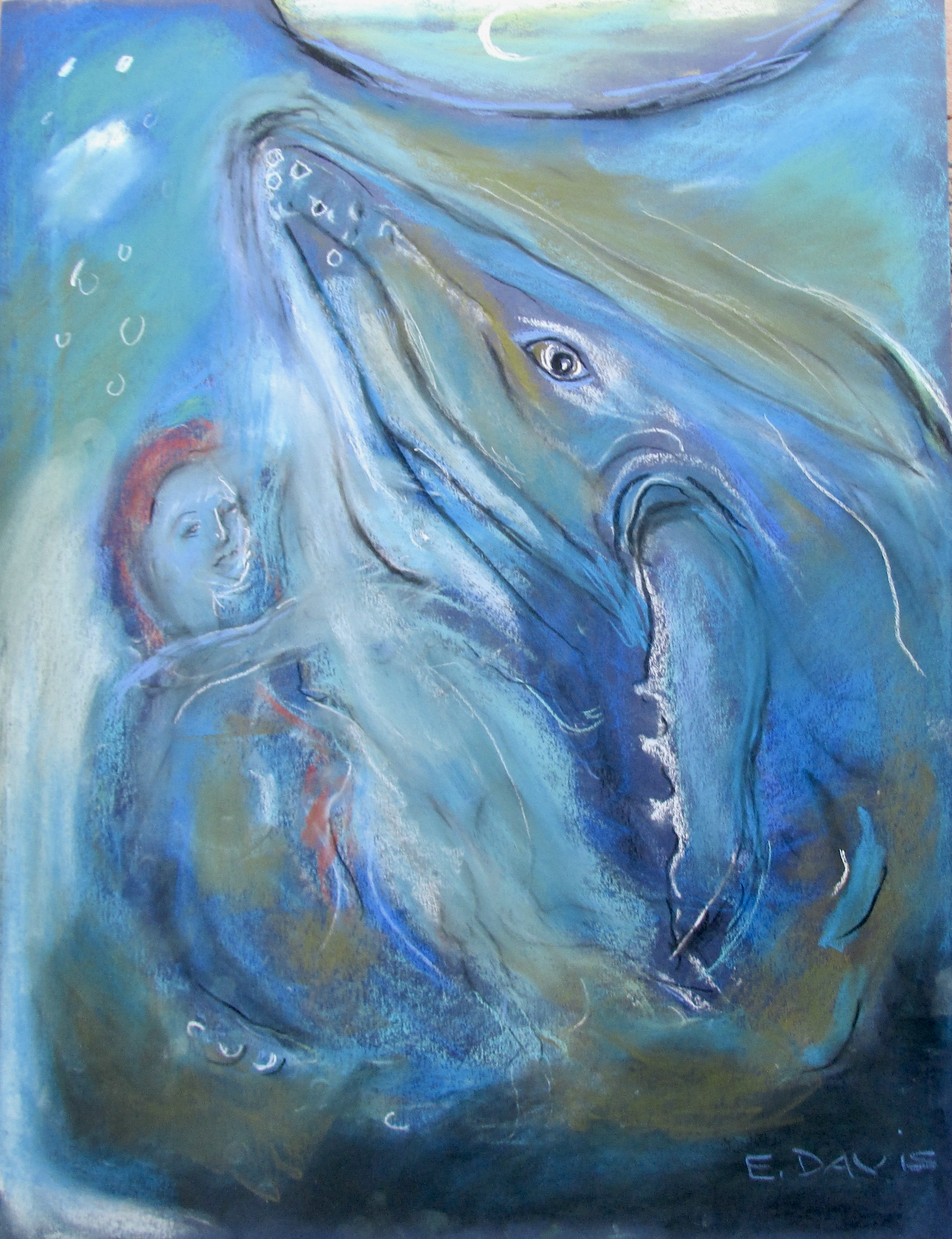
The Woman and the Whale

a pastel by Ethel Mortenson Davis

Leave a comment

Filed under Art, Art by Ethel Mortenson Davis, Ethel Mortenson Davis

The Woman and the Whale

By Ethel Mortenson Davis from her new book, The Woman and the Whale

The day was a day of celebration.
A small Right Whale stood vertical,
head out of the water,
straight up in the air,
his dorsal fins reaching like arms
toward the sky.

A woman diver
from a South Pacific Island
said the whale tried to tuck her
under his dorsal fin
when she interacted with him.

At first, she struggled to get away—
until she saw the shark
circling her, trying to get at her.
The whale kept his body between
the diver and the shark.

Then the whale grew agitated,
slapped his tail at the shark,
before finally running it off.

Today, the whale came back with his family,
many heads sticking straight up in the air.

Leave a comment

Filed under Ethel Mortenson Davis, poems, Poetry, Published Books

Dying and the Mystery of Absence

When Ethel Mortenson Davis and I created this site while we lived in New Mexico, we did so partially to make sure that we had a creative place to not only showcase some of the poetry and art we have both produced throughout our lifetimes but to also honor our son, Kevin Michael Davis. Kevin had died in Poughkeepsie New York where he was a web designer for Vassar College after a short struggled against aggressive cancer. While we put this blog together, we were both still in the throes of grieving and trying to deal with Kevin’s loss.

The new anthology is available at https://www.amazon.com/Leaving-anthology-poetry-mystery-absence/dp/1999740831/ref=sr_1_1?crid=S3YX5MBBHIVN&keywords=Leaving+Bennison+Books&qid=1699623562&s=books&sprefix=leaving+bennison+books%2Cstripbooks%2C104&sr=1-1

6 Comments

Filed under Ethel Mortenson Davis, poems, Poetry, Thomas Davis

Orchid Dancer

After the wedding between Sophia Wood and Erik Saucedo

by Ethel Mortenson Davis

Story of the Marriage of Two Souls

The orchid dancer
worried all night
that the storm
would keep the two souls
from being married.

But the jumping waters
that dance into the sky
did not come.
The love of the village
was so great that it
pushed back the whirling winds.

The two souls were
finally married,
and everyone celebrated
long through the night.

An eagle had flown over
earlier that day
and told us it would be so.

2 Comments

Filed under Art, Art by Ethel Mortenson Davis, Ethel Mortenson Davis

Sophia and Erik’s Wedding

At our granddaughter Sophia's wedding, Ethel wrote one poem for the wedding that she read out loud during the ceremony.  A friend of our daughter Mary read another poem by Ethel that was written 55 years ago during our courtship.  Then, at the reception I sat down and wrote a poem commemorating the event as the mariachi band played and people people danced as sunlight streamed out of the clouds for the first time all day.

The poem Ethel read:

Hope

Dear Grandmother,

today your great, great granddaughter
is getting married
to a fine, young man,
and they promise their love
is greater than their parents’ love
and their grandparents’ love.
They promise they will be happier
than their parents were
or their grandparents.
And they promise their children
will be loved more than all 
the ancestors put together.

Dear Grandmother,

this is their promise,
and this is our hope.


The poem from 55 years ago:

How Could I Know?

It looks to me as though
you’ve been around, perhaps,
since time began—
and I have lived at least
as long.

Oh? Only that much time?

I’m sure there was no life
before for you or me.
How could I know your face
so well?

As well as some old rock
I’ve seen hang, clinging
to a mountain wall,

and I know what wave of brightness,
or of darkness, to expect there
waiting for me.

You step and make some rounded move.
I know beforehand which way to go.

How could I know?  Unless. . .
You’ve been around, perhaps,
since time began.

I know I’ve lived at least as long.


The poem I wrote:

At My Granddaughter’s Wedding

First the bald eagle above the bay,
water dancing light on lines of waves,
then cranes in the greening field,
Babies and parents communicating 
with legs, moving necks, and wings in the sun,
and then the rumor of storms
brewing black clouds in the north,
stirring with big winds.

But then, after a night of worry,
the ceremony was to be outside,
the wedding day came, cloudy,
a fifty percent chance of rain.

But then the rain didn’t come.
Wedding roses lined paths
to the small wooden church.
Then, the words as ancient 
as human spirits, were spoken
by the bride and groom,

and then the sun came out
as the mariachi celebration began,
as clouds thinned,
and my granddaughter and her love danced
as music rose into an evening sky—

and love was everywhere.
Everywhere.

6 Comments

Filed under Ethel Mortenson Davis, poems, Poetry, Thomas Davis

Sherry Grant from Auckland New Zealand,

a classical musician and poet, sent Ethel a poem about one of her drawings:

Sherry Grant’s poem:

To Your Melody


By Sherry Grant (Op.2786)
2021-11-22


Utter magic! Webs of colours you freely spin,
Bittersweet young passion, time left beguiled,
Hesitant tears rush, sensation penetrates skin,
Hopelessly tangled knot, hearts racing wild.
At the edge of a dream two unicorns meet,
Sigh after sigh, clearer the shape of ecstasy,
Each ascension a fresh fountain so sweet,
This heaven built for you and me, our intimacy.


©️ Sherry Grant, Auckland, 2021-11-22, Op.2786
Inspired by ‘To Music’ by Franz Adolf Friedrich von Schober (Germany, 1796 – 1882) and
Alexander Scriabin‘s ‘The Poem of Ecstasy’ (Le Poème de l’extase), Op. 54
©️ ‘Song of Ecstasy’ (pastel) by Ethel Mortenson Davis (USA)
https://fourwindowspress.com/2012/01/14/song-of-ecstacy

Ethel Mortenson Davis’s drawing that inspired the poem:

1 Comment

Filed under Art, poems, Poetry

Forget-Me-Nots

Spring Garden and a Poem by Ethel Mortenson Davis

Circle

So fragile the circle

of the earth.

Clouds swirl upon her

in endless feathers.

All life surrenders to her.

She even brings you

back to me.

3 Comments

Filed under Ethel Mortenson Davis, Photography, poems, Poetry