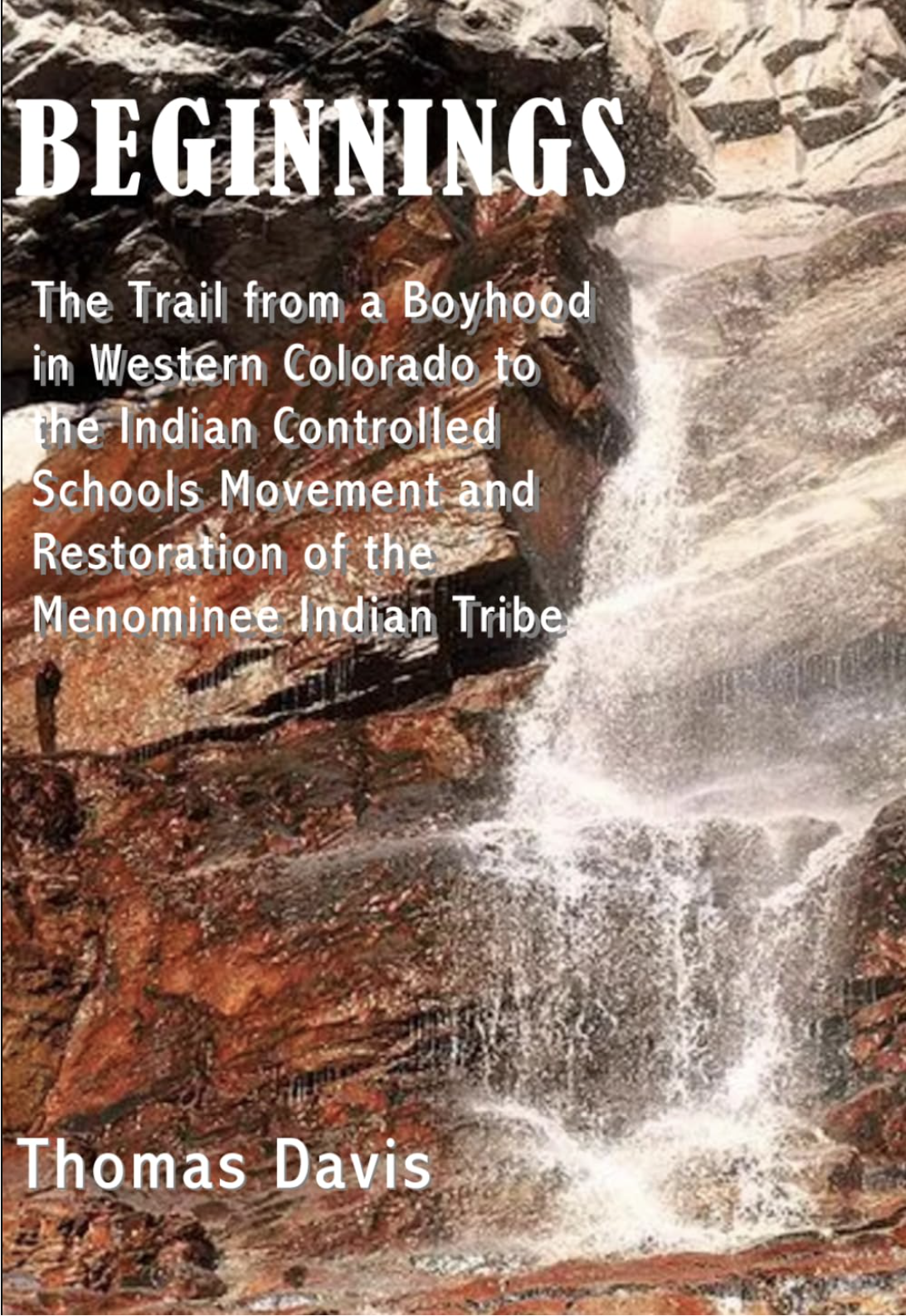
Finally! After two years my autobiography of my years in Western Colorado and working at the Menominee County Community School and the Menominee Indian Tribe has been published. I have copies in hand that can be found or ordered in bookstores throughout the world and all major online venues like amazon or Barnes and Noble. The book tells of growing up in Delta and Grand Junction Colorado, my love affair with Ethel Mortenson Davis (still happily married after closing in on 59 years), and so much history from the early 1970s that occurred because of the remarkable Menominee leaders of those days, resulting in the Indian controlled schools movement and the restoration of the Menominee Tribe and the start of the dominance of the self-determination era that changed the relationship of American Indian Tribes to state governments and the federal government. I was a participant in what happened, an observer.
Part of the reason I wrote this book is to rescue a part of American education and American Indian history that seems to be in danger of being lost. The Indian controlled schools movement was short-lived, but it was the spark that led to the creation of the tribal colleges and universities, which I have played a part in moving forward all these decades, and the contract schools operated by nearly every tribe in the country. The innovations from that movement are still echoing throughout American education.
The history of the Menominee Restoration Committee and its creation of the contemporary Menominee Indian Tribe of Wisconsin is every bit as important since this was one of the major foundations of the Self-Dermination era in tribal and government relationships that changed the arc of American history.
There are also stories about the Menominee Indian Warrior takeover of the Alexian Brother’s Novitiate outside of Gresham, Wisconsin that made international news, the rise of the Posse Comitatus in Shawano County (one of the first major right wing militia groups), and how a handicapped Colorado boy overcame his limitations and insecurities to find love, the strength of Indian values and Indian people, and a small place in the history of this country and its relationship to Native people.
Hopefully readers will find the history informative, the stories exciting, and understand that their lives have been impacted by what happened back then.
Although Beginnings: The Trail from a Boyhood in Western Colorado to the Indian Controlled Schools Movement and Restoration of the Menominee Indian Tribe chronicles the work of the Menominee Restoration Committee and the formation of formal tribal government after the Termination Era in American Indian history—helping usher in the era of Indian Self-Determination—it is a different kind of book.
For one thing, in the Western Colorado sections and in the chapters where I recount the magical love story between Ethel Mortenson Davis—the poet, artist, and my wondrous wife—I integrate narrative poetry into the larger story of being born in the small town of Delta, our move to Grand Junction, our marriage and early years together, and, finally, my success in earning a teaching degree in history and English at the University of Wisconsin–Oshkosh.
The other aspect of my story during these years was the struggle against physical handicaps caused by Charcot-Marie-Tooth disease, a hereditary disorder that affects much of my extended family. The theme of how physical handicaps can affect American children growing up in a culture that extols exceptionalism while often denigrating intellectual and physical disabilities is, I believe, both powerful and universal. I was fortunate that my particular affliction was one I learned, somewhat shakily, to overcome, partially because of the glory of falling in love with Ethel.
I am often asked whether I am American Indian. Then, after I answer, another question follows: How did a Western Colorado boy end up spending most of his life serving American Indians through the Indian-controlled schools movement?
That question reflects the difficulties American society has always had in embracing the patchwork quilt of its own population. In my story, I move from being a true-blue inheritor of the Western ethic of independence, self-reliance, and connection to the landscape to becoming a participant in the effort of Indian people to control their own futures within a country that has often preferred to deny the history of the Indian Wars and the treatment of Native peoples after the wars ended and the Treaty Period gave way to new federal policies.
This meant that I became a participant in some of the most important historical movements in modern American history: the birth and development of the Indian-controlled schools movement and the legal and political foundations of the Self-Determination Era, which recognizes tribes as independent nations possessing constitutional and treaty rights that have too often been violated by national, state, and local governments.
The Major Themes of Beginnings
There are many major themes woven throughout Beginnings. I hope readers discover many of them for themselves.
The Power of Beginnings
How childhood experiences shape a lifetime of values, decisions, and leadership.
The Formation of Character
Lessons learned through family, work, hardship, and responsibility in rural western Colorado.
Leadership Through Service
Leadership emerging from commitment to a cause rather than the pursuit of authority or recognition.
Finding Purpose
The unexpected path from a small-town upbringing to involvement in national Native American issues.
Education as Self-Determination
Education as a means for communities to control their own future rather than simply transmit knowledge.
The Indian Self-Determination Movement
The historic transition from federal control toward tribal governance and local decision-making.
The Menominee Restoration
The political, legal, and human struggle to restore federal recognition to the Menominee Tribe.
Community Building
Creating institutions that outlast individuals, including schools, organizations, and partnerships.
Cross-Cultural Learning
The mutual education that occurs when people from different backgrounds work together with respect.
The Importance of Listening
Effective leadership beginning with understanding rather than directing.
Courage During Change
Individuals willing to challenge established systems in pursuit of justice.
Ordinary People Making History
How significant historical events are often shaped by people who never intended to become historical figures.
The Evolution of Tribal Education
The emergence of Indian-controlled schools and, eventually, tribal colleges as expressions of sovereignty.
Institution Building
The practical challenges of creating new educational and governmental institutions from the ground up.
Perseverance
Continuing despite political setbacks, financial uncertainty, and organizational obstacles.
Relationships and Mentorship
The influence of remarkable individuals whose guidance changed the course of my life.
The Intersection of Personal and National History
One person’s life unfolding alongside transformative events in federal Indian policy.
Hope and Renewal
Restoration not only of a tribe’s legal status but also of dignity, identity, and opportunity.
The Value of Place
The landscapes of western Colorado, Wisconsin, and Indian Country as active influences on identity and perspective.
History Through Personal Experience
Understanding major historical movements through the lived experiences of someone directly involved.
Beginnings ends before the years I spent helping establish and expand the tribal college movement—the work for which I am probably best known at the age of eighty. That story belongs to another volume.
For now, I hope readers find in Beginnings a story that contributes to a broader understanding of this country, its history, and what it ought to stand for.