an epic poem by Thomas Davis
His stupefaction, as he sat in snow
Beside the boulder as his pain seared skin,
Kept him from seeing Cragdon packing up
To struggle back the way they’d come across
The treachery of fields of blinding snow.
“I’m leaving now,” the young man said, his face
A mask of pain where dragon’s fire had burned
His arm and side. “I’m done. I’m going home.”
Ruarther, from his seat, looked up and stared
Into the young man’s bleary-looking eyes.
“You’ve lost your mind,” he said. “We’re injured bad.
Until we’ve got our hurts controlled, the village
Is just a dream you’ll never reach alive.”
The pre-dawn cold was hinting at the light
Now filtering along the eastern ridges.
“I knew I’d have to go alone,” the young man said.
“You’re crazy. Why I followed you out here
Is something that I’ll never understand.”
“The witch’s child has stirred the dragons up,”
Ruarther growled. “You’re suffering from burns
Inflicted by a dragon hurtling
From skies without a reason made by us.”
“Perhaps it read our minds and gave us warning
That murdering a child is not the way
To keep the human, dragon peace,” he said.
“I’ll send the hunters out with fresh supplies.
You’ll have to keep alive until you’re found.”
Ruarther looked inside the raging self
That seemed to boil with pain and anger branded
So deep it was the substance of his life.
He growled again, but did not say a word.
As Cragdon looked at him, the man he’d seen
As better than a man could ever be,
His hero since he’d been a child who’d hung
Upon the village’s stone wall to watch
For hunters coming from the woods, their game
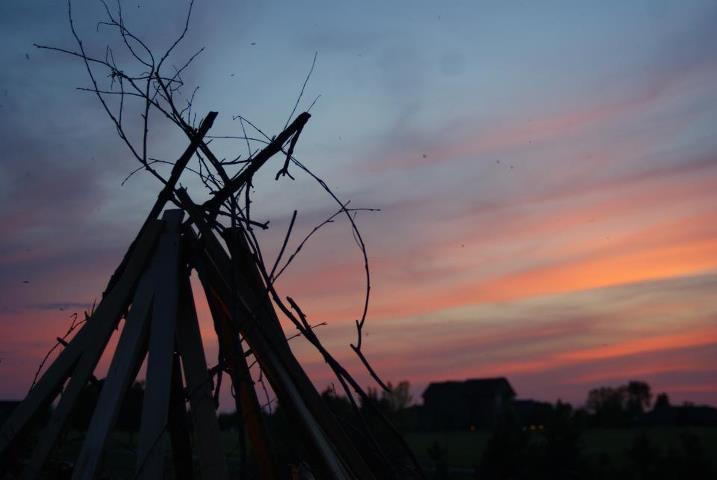
On tripods made of fresh-cut branches roped
Around their hips, or slung on massive shoulders,
And wondered why he’d failed to see the truth.
The grim, dark man who leaned against the boulder
Was not a village man, but bound
To raving spirit beasts whose sentience
Danced chaos born from rage into the world.
He shook his head and looked toward the slopes
That angled down toward the only place
He really cared about inside the world.
“I’m going now,” he said. The snow shined brightly
As sunrise danced with sky fire as it crept
Across the treacherous, white miles of crust.
He wondered if he had the strength to make
It to his wife and child, the life he loved.
He briefly wondered where the dragon was.
It too was facing weeks of burning pain.
He shook his head, then moved out from the ridge.
Ruarther failed to hear, or see, when Cragdon
Began his journey home. He fought to block
His pain from consciousness and tried to focus
Upon the task of finding peace again
By murdering the witch’s child and letting dragons
Go back to living in their caves away
From hunters and their villages and homes.
He tried to see the child’s unnatural eyes
And wondered how a witch with minor skills
Could birth a witch so powerful her strings
Turned dragons into puppets of her will.
He felt the golden dragon’s whirling eyes
Confront him, heard the power in her voice,
But when he looked around to see her body,
The wilderness and sky were empty, vast
Beyond imagination, fevers wrapped
Around him like a fire inside his flesh.
He cupped snow in his hands and spread its cold
Upon his burns and coughed deep in his lungs.
He wondered if he’d be alive when dawn
Lit up the sky again and wheeled another day.
But then he knew: He’d kill the witch’s child.
He’d give Ruanne the peace his love deserved.
He’d let the dragons settle back into their lives.
He forced himself onto his feet and put
More wood to burn upon the dying fire.
Click to hear an audio of this section: Separation in the Wilderness
Note: This is the sixteenth installment of a long narrative poem. Inspired by John Keats’ long narrative poem, Lamia, it tells a story set in ancient times when dragons and humans were at peace. Click on the numbers below to reach other sections, or go to the Categories box to the right under The Dragon Epic. Click on 1 to go to the beginning and read forward. Go to 15 to read the installment before this one. Click on 17 to go to the next installment.





 fourwindowspress