
photograph by Sonja Bingen

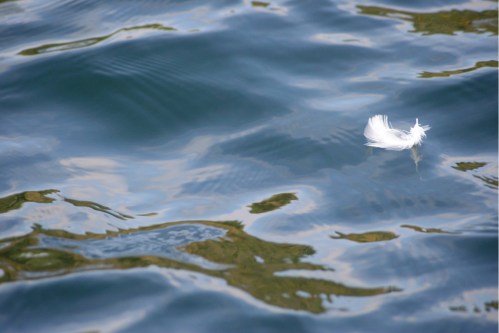
Wooly Bear Caterpillar
by Ethel Mortenson Davis
I’ve come to lie
my head again in your lap
this Wooly Bear morning:
Frost in the air,
the sky unbelievably blue,
the leaves red-orange.
I reach down and touch
The softness of the caterpillar’s
black and brown bands.
She quickly springs into a ball—
so strong, so resilient:
Strong enough to survive
90 below zero in arctic winters,
spinning a cocoon
and then in spring
turning into a Golden Isabella moth.
This strength is something
to take home with us
and rid our toxic relationships,
disregarding them like clothing
we let drop around our ankles
and step away from
with a new nakedness,
frankness,
ready to start building
new cocoons that turn us
into golden moths.
Filed under Ethel Mortenson Davis, poems, Poetry
On Writing Sonnets
by Thomas Davis
The writer who wants to write a sonnet must set out to write a sonnet. A free verse poem can conceivably come completely out of the subconscious. The poet might not even set out to write a poem, but a poem forms itself on the page as the writer is writing, or they select passages from a journal that can be turned into a poem.
Traditional verse poems like the sonnet demand that the poet set out to write in this or that form when they begin the poem. Creativity itself comes from blending sensations from the environment, thoughts, emotions, sight, sound, smells, touch, conversations, events, philosophies, and other elements of what affects human beings into a new whole whether that comes to be a poem, a painting, or a new scientific finding. Therefore the sonneteer draws upon innate creativity and sets out to pour it into a specific language and form.
This intentionality is also present as the sonnet flows from the poet’s pen. Tools like a rhyming dictionary or thesaurus can be helpful. English is not as natural language for rhyming as Italian. There are fewer rhymes available. That’s one of the reasons near rhymes can be useful at times. To avoid a trite singsong quality to the verse the sonneteer also needs to avoid always using a single syllable male rhyme at the end of every line. Multiple syllable, and even alternate feminine/male rhymes, can be useful in creating a more complex music. Enjambment between quatrains, octaves, sestets, or even couplets, as well as alliteration and assonance, can also help in pursuit of a music that breathes and engages the reader.
Iambic pentameter, as has often been pointed out, is the most natural rhythm for language in English. This is not nearly as true in other languages. The Odyssey, A Modern Sequel, an epic masterpiece by Nikos Kazantzakis, written in Greek, has seventeen syllable lines. In Greek it sounds magnificent, although I cannot speak Greek. In English it looks and sounds impressive, but mostly because the lines seem wildly long and filled with a rich, “O sun, great Oriental, my proud mind’s golden cap,” overblown profusion of metaphor, personification, and other figures of speech. Iambic pentameter, with its simple patterns of un-accent, accent, comes much closer to everyday speech.
From the first line on, the sonneteer needs to write lines using Iambic pentameter. I often think in meter on my morning walks with my wife just so that I can use meter without straining when I sit down to write. I also try to listen to the rhythms of speech is people’s voices and listen to the meter I hear. This is not necessary, but one of the most vital rules for writing a good contemporary sonnet is to not use tortured syntax in order to get either the meter or rhyme to work. Practice can help achieve this end whether the practice is in your head or on paper.
Also important, as in all other writing, whether it is an essay, a poem, or a novel, is to mix sentence styles as the sonnet comes into existence. A sonnet can be written using a single sentence, or course, but this can be extremely difficult, especially if the volta is to bring life to what is being written. Sentences, properly constructed, but also varied, are important. They become part of the overall music.
There are exceptions to the mixed sentences rule. Repetition can be a powerful device for building both music and emphasis. One of the great examples is from the King James Bible, Samuel 2, 18:33: “And the king was much moved, and went up to the chamber over the gate, and wept: and as he went, thus he said, O my son Absalom, my son, my son Absalom! would God I had died for you, O Absalom, my son, my son!” Repetition, either words or sentence types, repeating, say, a declarative sentence, if used rarely, can be a powerful literary device.
A sonnet is, in the final analysis, a poem. It involves the right and left hemispheres of the brain, the logical and intuitive spheres. It is derived from a long poetical history that stretches from narrative poetry like Beowulf or the work of Homer to the white goddess incantations of Celtic poets to the innovative work of Hopkins to the genius of William Shakespeare to the contemporary anguish of John Berryman in Berryman’s Sonnets. In some ways the sonneteer is drawing from this history each time they sit down to write. Its form is incidental to that long history. By writing a sonnet the poet is become part of the long flow of poetic history.
Sir Thomas Wyatt and Henry Howard, Earl of Surrey wrote the first sonnets in English, using primarily the Italian, Petrarchan, form. Wyatt’s use of iambic pentameter was not as sophisticated as later poets. Henry Howard was smoother and created the English sonnet that later became known as the Shakespearean sonnet. Most early sonnets written in English were lyrics, but the river of poets that followed these pioneers have written narratives, lyrics, and descriptive and didactic poetry. Giacomo da Lentini, a Sicilian, who wrote close to 250 Italian sonnets, was the first person to write a sonnet. Most early sonnets were love poems. Lending itself to compressed intensity, it was, at least at first, considered the perfect medium for the expression of love and passion.
The sonneteer writes a sonnet by sitting down, either at computer or table, and writing one. They write in iambic pentameter, choosing a traditional rhyme scheme or experimenting. They draw upon the nature of their creativity, drawing inspiration from nature or their humanity or their philosophy, becoming a part of the river of sonnet writers that have flowed through literature’s history.
May your sonnet dance like a song, sing the fragrances of lilacs in spring, touch like a lover’s touch under the oval silver of a full moon.
being to timelessness as it’s to time, by e. e. cummings
being to timelessness as it’s to time,
love did no more begin than love will end;
where nothing is to breathe to stroll to swim
love is the air the ocean and the land
(do lovers suffer?all divinities
proudly descending put on deathful flesh:
are lovers glad?only their smallest joy’s
a universe emerging from a wish)
love is the voice under all silences,
the hope which has no opposite in fear;
the strength so strong mere force is feebleness:
the truth more first than sun more last than star
-do lovers love?why then to heaven with hell.
Whatever sages say and fools, all’s well
Filed under Essays, Thomas Davis
The Cedars Heard . . .
wind talking with waves sweeping into dolomite cliffs, and they began to move as if they were not rooted to earth, but dancing with air and sky . . .
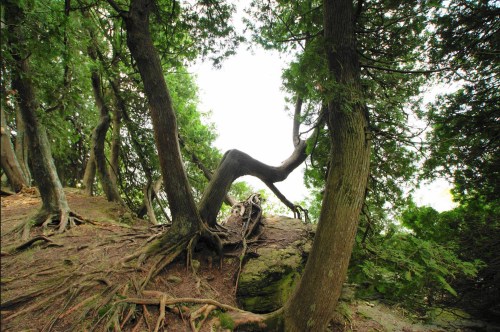
a photograph by Sonja Bingen
Filed under Art, Photography
Review of The Weirding Storm, A Dragon Epic
The Peninsula Pulse, a publication with a 15,000 circulation, has just posted a review of my book, The Weirding Storm, A Dragon Epic. I am thrilled with Jack Jaeger’s review. The reviews the book has received so far have all been positive. I am so grateful to Bennison Books for publishing it. I was surprised too by the $9.50 price tag, so I am hopeful it’s affordable to an ever-growing audience.
The review is posted online at https://doorcountypulse.com/weirding-storm-dragon-epic-time.
The print copy includes the “Invocation to the Dragon Muse”, which follows epic convention and introduces the story. The online version does not, but I am grateful to all of those who have reviewed it so far on amazon.com, barnesandnoble.com, and in other venues.
What has amazed me is that the reviewers seem to all be picking up on the relationship of the story to the current world. The novelist D.M. Denton and a college instructor from Tennessee, Dana Grams, both noted that relationship as does Jaeger. I thank all of them and am hoping for more reviews to appear. Tom
Filed under Poetry, Published Books, The Dragon Epic, Thomas Davis
An Angel of Sorts
To Ed DiMaio
by Ethel Mortenson Davis
I must tell you
that sometime
when all is lost,
when there is
no more hope in the world,
the great cosmos,
the lovely universe,
puts on our path
a free spirit,
an angel of sorts,
or a person of faith —
and says,
“Here is your protector,
the one who will lift your soul up,
the one who has come
this evening to be your guide
to position yourself again
in the universe.”
And now he says,
“How comely you are,
how lovely your skin,
how grand your soul.”
Now you have your answer,
the answer to Hopelessness:
Unexpected grace.
Filed under Ethel Mortenson Davis, poems, Poetry

Hurricane Harvey, the Governor and President
by Thomas Davis
They sat, the Governor and President,
Before the bristling microphones, the flood
Of waters on the earth, and, as they bent
Catastrophe into the pounding blood
Of prayers full of self-congratulations,
Old people sunk in wheelchairs, their thighs
Beneath the murky waters as, forsaken,
A child clung to its mother–as she dies.
Inside the microphones, great power spoke
And broadcast masks of headlong recklessness
As children cried and scores of parents woke
And saw the water’s rising deadliness.
In wind and water Gaia spoke to those
Whose voices bragged about their glorious woes.
Filed under poems, Poetry, Thomas Davis
 fourwindowspress