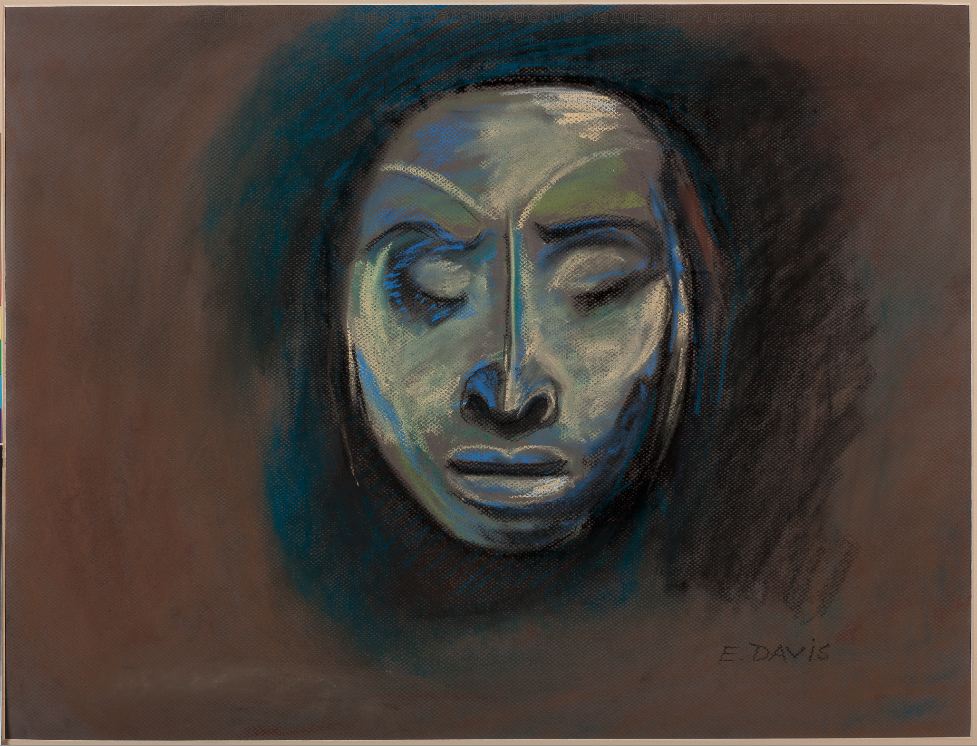
Autumn

Photograph by Sonja Bingen

poem by Ethel Mortenson Davis

She listens
as closely as a lover listens
for the first
sign of her love’s approaching.

Suddenly,
she rushes and embraces winter,
quieted and covered by the coolness
of his death-white arms.

Leave a comment

Filed under Art, Ethel Mortenson Davis, Poetry

Old Galrug, a Dragon Ballad

by Thomas Davis

Deep in the swamp inside a cave,
Inside obsidian
That rises shining from the mud
Beneath a midnight sun,
Old Galrug sits and broods about
When dragons have to run

From puny men so small and ugly
And insignificant
That dragons ought to have the strength
To breathe long flames and let the brunt
Of greatness cause a scurrying
By frightened, cowering runts.

But in the gloaming wilds where forests
Loom high above the ground,
Old Galrug, feasting on a stag,
Was startled by the sounds
Of horses jangling through the woods
And turned, his rage unbound.

His nostrils streamed with smoke and flame;
He roared alive the world.
The leading knight came charging through
The trees and swung and hurled
A shining strand of woven rope
Abruptly, swiftly curled

Around Old Galrug’s swaying neck.
His rage transformed to fright
As other knights came charging, ropes
Strung over ropes, winged flight
Impossible as yet more ropes
Bound wings to body, tight.

The knights drew swords and brandished them
As horses charged his flank.
The biting of the gnats drew blood.
He writhed his body, shrank
Away from blow that followed blow.
His raging mind grew blank.

As slashes, pricks of sharpened swords
Sucked life through grievous wounds,
He slashed his tail in his fear
And ripped his body from the goons
Surrounding him and ran into the forest’s
Twilit, welcome gloom–

And as he ran he shed the ropes
That bound his wings and tied
Him to the ground where men were loud
With rage and cursed his hide
And forced their frightened horses forward,
Hearts bent on dragoncide.

He flexed his wings and struggled up
Into the heavy air,
Blood flowing from his dozen wounds.
The cries of men’s despair
A music ringing in his ears,
He flew toward his lair.

But now, inside his cave, he brooded, thought
About the dragons killed
In wars as old as dragon-kind—
The way men gathered, filled
Themselves with dreams of bravery
And dragons’ heartbeats stilled.

Why did so many have to die?
He asked himself. He thought
About the solitary paths
That dragons always sought,
Protecting human gold and other wealth
Their wiles and cunning bought.

Our solitude is killing us,
He thought. It is our flaw.
Inside obsidian he blazed
Frustration as he saw
His weakness lay inside his self.
He gnashed his massive jaws

And spread his massive purple wings
And breathed his stomach’s fire
Into his throat and, wounded, sick,
Displayed his dreadful ire
By roaring at a midnight sun,
Expressing his desire

To end the plague of human brains
That worked to end his kind
And make the world a better place
For human hearts and minds
So they could live their sentience
While dragon life declined.

As fires built deep inside his belly,
He spread his purple wings
And launched into the sun-weird night,
His rage a dragon scream
That had no mind, no hope, no aim
Except destruction’s sting.

He flew inside his red-eyed pain
Until he found a human place.
He shrieked from skies, a shaft of hate
That hurtled, clawing grace
Into the humans screaming, running
As lives were smashed, erased.

Exulting in his power, hate,
Old Galrug tried to roll
Away from ground that loomed too fast,
But as he turned, the toll
Of injuries inside his hatred bled
A flaming aureole,

Filmed over eyes abruptly blind,
And struck into his hearts
As pain became the universe,
And life became a part
Of some lost dream that dragons dream
As life, at last, departs.

The dragon crashed into the ground
And wailing shivered skies
And dying humans reveled at the ending
Old Galrug faced, his cries,
Malevolence, now blind
As, wracked with pain, he died.

1 Comment

Filed under Poetry, Thomas Davis

Panther Moon, an abstract pastel by Ethel Mortenson Davis

Leave a comment

Filed under Art, Art by Ethel Mortenson Davis

Life

by Ethel Mortenson Davis

we went past
somebody’s place,
and there were things
sitting all over
and kids
and a woman looking
out a window
at a cat,
and the kids
were in puddles
with their eyes in oceans,
and they were waiting
for a storm or something,
and the place
looked twice as junky
as it did when the snow was,
but it didn’t matter
because it smelled warm,
and the sky was heavy,
and life stood in the mud, open-mouthed.

Leave a comment

Filed under Ethel Mortenson Davis, Poetry

Overlooking Versailles Gardens

This photo was taken on November 15, 2009 by Alazanto, Kevin Davis, our son.

2 Comments

Filed under Art

The Lyric’s Gone

by Thomas Davis

As middle age begins to creep
into the muscles of the heart,
the lyric impulse starts to die,
and words that blinded with their flash
and dazzle start to plod and groan
inside their cage of sentence-flesh.

Still, love is still as bright, my love.
Its fires are not as blazing hot,
nor are its rhythms quite as full
of cleverness and silk delight.

Its rhythms lengthen out to merge
with other rhythms pulsing life
and time and thought and loving moods.

I love you still; it’s you I love.
The lyric’s gone, but still, we love.

1 Comment

Filed under Poetry, Thomas Davis

Gray-White Geese

by Ethel Mortenson Davis

Put your arms around me
to keep the desert winds
from blowing through me.

Now!

As the snow clouds have gathered
like gray-white geese
gathering on water.

1 Comment

Filed under Ethel Mortenson Davis, Poetry

Navajo Mark Study, a design by Alazanto

Navajo Mark Study

“This was an opportunity to work with Navajo symbolism to convey education in the digital age.” Alazanto, our son, Kevin Davis, on his website, http://www.alazanto.org, accessed 10/7/11.

Leave a comment

Filed under Art

Occupy Wall Street!, but Don’t Run your New Model T into a Gully in the Middle of Nowhere

My mother, at eighty-five, tells the story of when she was a young ten year old girl in Oklahoma. Her grandfather, a farmer with a wonderful old barn he had built with his neighbors, bought a Model T. He had driven a team of horses his whole life, but finally broke down after his neighbors all started buying into the newfangled form of transportation. After teaching himself to drive, he often went to town and took his granddaughter with him.

However, his driving skills were never perfect. He could not get used to an engine that could not understand the English language. He kept telling the car to “Whoa!” and “Hurry up!” Sometimes he remembered about gears and brakes and sometimes that was beyond a lifetime of habit.

One day he decided to go visit my mother’s uncle in an Oklahoma town far enough away that the only option, if it was a day visit, was the car. My great grandmother had farm work to do, so my Mom and great grandfather got into the dust-covered black Ford. Everything went well at first, but then “Grandpa,” as my mother called him, got to mumbling to himself the way he did when driving the team of horses that lived in the barn. Pretty soon the car was wandering out of the dirt road toward the gullies that ran beside the road.

Then, suddenly, Grandpa came out of his reverie, terrifying the ten year old in the seat beside him, and started saying, “Whoa you son of a bitch! Whoa!” as the car headed toward the deepest gully they had come across since leaving the farm.

“Hit the brakes, Grandpa!” my mother said. “Hit the brakes!”

“Tell the goddamned son of a bitch to stop!” Grandpa roared.

Miles from nowhere, during a time when there was no guarantee another car would pass that day, the car jolted into the gully. Neither Grandpa nor granddaughter were hurt, but Grandpa put his forehead on the black steering wheel and said, “son of a bitch.”

Telling the story my mother never uses the exact language she heard my grandfather use. Ladies still do not use that language in public, according to her lights. Yet, she has a way of making sure you understand exactly what my great grandfather said.

What is important about this story, at least to me, is that it illustrates just how mutable time is and how difficult a time we humans have adjusting. We get comfortable with our lives, especially as we get older, and then some newfangled technology comes along, our neighbors and friends grab onto it, and suddenly the “son of a bitch,” useful as it may be, is a team of work horses who refuse to obey our commands. Our habits and past conflict with present realities, and we suddenly find ourselves in a gully in the middle of nowhere with a steaming carburetor and responsibility for not only ourselves, but our grandchildren.

My mother has no memory of how her grandfather got them out of the predicament he had gotten them into, but she remembers his red face, banging on the black steering wheel, and his frustration. Life had gotten out of his control–at least for that moment.

Change has been speeding up for most of my lifetime. I remember a moment on the playground of my school in Delta Colorado when one of the sixth graders mastered an impression of Elvis Presley, who was the newest rage among teenagers. The school principal was not amused by his hip grinding and wild rock n’ roll gyrations, so different from the church choir music he liked, so the sixth grader was hauled into the office. This caused an explosion caused by the sixth grader’s friends. Pretty soon the school yard was filled with elementary school kids chanting, “We want Elvis! We want Elvis!” I had no idea why we were all chanting until I got home from school and had to face my Mom, but I chanted anyway.

This pop culture change has kept going from Elvis to now. The other day at Navajo Technical College I had a young woman in my office that had metal studs arced across the top of her forehead in rainbow colors. She was not in my office because I was upset by the rainbow embedded in her forehead. If I was upset by that I could not be a Dean of Instruction at a contemporary college. But the point is that I thought it was normal, a part of the pop culture scene that changes every few months as young people reach out for actions and decorations guaranteed to upset their elders.

Whether the change is large, the replacement of a culture built around horses with a culture built around automobiles, or small, embedded metal studs in a beautiful face, change creates a change in each of our individual and group landscapes. Change outside of us creates change in us.

I watched Ken Burns’s Prohibition mini-series on television during the last several nights. One thesis of the show was that the growth of immigrant population from Eastern Europe created part of the undercurrent in convincing enough of American citizens to pass the Eighteenth Amendment to the Constitution. Other currents were present in the movement as Progressives of the era tried to protect the family from ravages of alcohol and envisioned a world where decency and the American way were the norm. But if the movement had progressive elements, it was, at the same time, deeply conservative. If the evangelists of the prohibition movement were progressive, trying to protect women and children, they were also reacting against the change in the American population. America was a great place if its character could be protected from the Irish, Polish, and other undesirables coming through Ellis Island to the mainland U.S. in droves.

In the end the unintended consequences of Prohibition were huge and, more often than not, undesirable: The organization of organized crime, the flouting of Constitutional law by millions of Americans, a jump in political corruption, and even a sharp increase in the consumption of alcohol by a dedicated group of anti-prohibitionists. Both the changes occasioned by immigration (sound like a familiar theme in today’s politics?) and prohibition moved masses of people as battles for the American soul were fought with passion and, sometimes, ruthlessness. Those who believed in prohibition stirred up those who believed a drink a day (plus a few) kept the doctor away, and event after event unfolded until suddenly the Great Depression created an environment where the Twenty-first Amendment repealing prohibition became inevitable.

Today we are seeing similar currents and cross-currents sweeping across the nation. The Tea Party clamors to return to an era that did not work while prohibition was in full swing, threatening to send the country into yet another Great Recession or Great Depression. Reacting to that young people are shouting out, “Occupy Wall Street,” while the media, which, after all, is owned by the conservatives who claim the media has a liberal bias, calls for the young people to clarify what they want even though anyone with two cents worth of brains can easily tell what they want. They want the wealthiest one percent of the country to have less wealth and the bottom 99% to improve their collective futures by a transfer of wealth from the top 1% to the middle and lower classes.

The Tea Party wants America to be America without changing another iota, letting wealth grow even more wealth, letting conservative religions dominate the political and social landscape, and letting Americans be Americans without the taint of illegal immigration mixing an “undesirable” strain into the American melting pot.

I will admit that I agree wholeheartedly with the Occupy Wall Streeters in New York. I believe the my-way-or-the-highway Tea Partiers are another version of the true believers Eric Hoffer once warned the world about. I do not believe they are so venous they will lead us into a Night of the Broken Glass as the radical conservatives of Hitler’s day did, giving power to the evils of Nazism, but in their pursuit of freedom they seem to be perfectly willing to attack anyone who disagrees with any item of their ever-more-radical agenda, refusing dialog and compromise, and ignoring facts in pursuit of conservative purity.

Change is never easy for individuals or groups. My mother loves telling the story of her grandpa, but grandpa inevitably was not as amused as she has become over time. The unintended consequences of prohibition should act as a cautionary tale, even to those who believe as passionately as I do that the rich, who Scott Fitzgerald said were different from the rest of us, need to become more like the rest of us for the good of us, including them. If I did not live so far away from New York City I would consider joining the Occupy Wall Streeters.

As I look at the struggles of Americans without work and without prospects, I am willing to take a chance, to chant “We want Elvis!” on the playground of life even though I understand, as an aging adult, that the action and reaction of humanity never creates a straight line toward ultimate good, but mazes into a pattern that might improve things if the force of history is toward progress rather than regression.

May what I believe end up as good as I intend it to.

Leave a comment

Filed under Essays

Genius: Mildred and Bill

by Thomas Davis

To Mildred Hart Shaw and Paul Pletka

A sherry in her hand, surrounded by
the books that filled the room from floor to ceiling,
she watched the young man, self-absorbed, apply
a tiny brush to lead-framed glass, a feeling
of richness emanating from a scene
of large-eared rabbits sitting in the snow
beside a gully, mountains rising white, pristine,
into a winter sky that almost glowed.

The glass had traveled west a hundred years ago
strapped in a wagon pulled by two huge horses.
“That’s good,” she said. “It has a Christmas glow.
No rivers, but it sets the rivers in their courses.”

“A Christmas door,” he said. “It’s here, but then
you’ll wipe it clean to make it just a door again.”

Leave a comment

Filed under Poetry, Thomas Davis