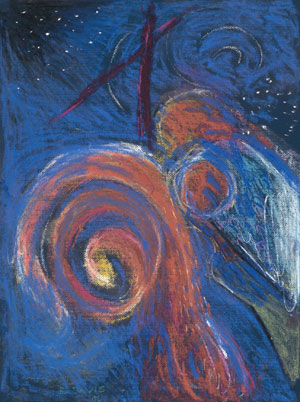
Auschwitz E. Poland, January 27, 1945 , a poem by Ethel Mortenson Davis

Deep January
never felt so warm–
when the strong arms
of the Red Army
picked up
the skeleton-like people
and set them
on blankets in the snow.

The evil snake
had reached down
deep into their bodies
and tried to snatch
their very souls,

but the soldiers
gathered them
like sick dogs
in their arms
and set them
into the sunshine.

Libertacja was like
the swinging
of a thousand swings
up into the air–
a day when poetry
began to be written.

Originally published in Gallup Journey, January 5, 2011

2 Comments

Filed under Ethel Mortenson Davis

Red Mustang, a pastel by Ethel Mortenson Davis

Leave a comment

Filed under Art by Ethel Mortenson Davis, Ethel Mortenson Davis

Creative fires start small, then build

For most of my life I have been interested in why explosions in creative genius occur. Mostly I have been interested in examples like the Renaissance in Italy in the 1400s, the flowering of Greek art during the classical period, the American Renaissance in New England in the mid 1800s, especially around Concord, and smaller explosions such as that which surrounded the founding of Black Mountain College in North Carolina in the mid 1900s. There are other equally important flowerings, if different in flavor and effect, such as the Silicon Valley technology explosion in California or the development of the Indian Institutes of Technology in India in the 1950s. The question is, why do these explosions of creative work occur? They have an enormous impact on human history, thought, inspiration, and even the rise, fall, and mood of nations, but what causes them to happen?

I have been fortunate in my lifetime to have witnessed three explosions of creativity, if not more. I believe I have witnessed genius brewing if not flowering. The most significant of these has been the formation and growing of the tribal college movement, which started with Navajo Community College in 1968 and is still transforming Indian country from Alaska to Michigan to Kansas and Oklahoma today. I have been privileged to work with people like Helen Maynor Scheirbeck, Lionel Bordeaux, Mike Gross, David Gipp, Carty Monette, Carrie Billy, Carol Davis, Verna Fowler, and so many others whose genius managed to help transform hopelessness on the nation’s American Indian Reservations into hope. In a speech given at the American Indian Higher Education Consortium’s Spring conference held in Green Bay, Wisconsin a few years back I described the founders of the tribal college movement as “giants that have walked on Mother Earth,” and I will honor them during all of my life.

But what I have been thinking a lot about lately is two different flowerings. One occurred when I was much younger in Shawano, Wisconsin. The other is the Zuni Mountain poets and the flowering around the Old School Gallery near the El Morro National Monument in New Mexico. Ethel and I lived in Shawano, where I helped found both the Menominee Indian School District and College of the Menominee Nation, longer than we have lived anywhere else. This is conservative country, home of the notorious Posse Comitatus, a place where Joseph R. McCarthy’s portrait still hangs in the court chambers of the Shawano Country courthouse.

Still, when the Mielke Theatre was built in Mielke Park in 1976, an arts movement developed in the rural part of Wisconsin that was as active as any in the entire state. The development of the movement was anything but smooth. Fighting over use of the theatre and funding and other issues, mostly inconsequential in the retrospect of years past, marred the short period of time when I was President of the Shawano County Arts Council and most of the years before that, but the point is that artists literally came out of the deep woods surrounding Shawano and began showcasing their work to the local area, inducing other artists of various kinds: Writers, visual artists, photographers, theatre people, and others, to create an atmosphere of intense, if conflicted, excitement.

When Ethel and I became involved in the Zuni Mountain poets, driving from our home in Continental Divide, NM nearly an hour and a half most Sundays, poetry group was already a strongly going concern. Held at Inscription Rock Trading Post and Coffee Company’s outdoor patio in the summer and its loft in winter, the group was already writing poetry that rivaled anything being written by the Wisconsin Fellowship of Poets, a major arts organization that Ethel and I had attended off and on for years. There was a little controversy, in a very minor key, surrounding the Zuni Mountain poets, but Jack Carter North, the unofficial head of the group, allows almost no negative comments about a poet’s work shared during meetings, and the result is astounding. Over the years young and poor poets have joined the group, but over time all of them have improved their work, if they kept coming to the meetings over time, without hearing a negative word during their patio or loft visits. I would be willing to claim that several of the poets writing, including Ethel, have a poetic genius.

My conclusion after seeing these three movements and reading about renaissance after renaissance that has occurred around the world, and visiting places like Taos, New Mexico where the renaissance that included artists like Georgia O’Keefe and the writer D.H. Lawrence, among dozens of others, happened is that renaissance occurs when one, or sometimes two or three, extraordinary presences, an artist or non-artist, creates a spark, often, but not always, with intent. That spark excites others and a renaissance starts building, each artist competing and harmonizing with others, the group building genius out of the desire in individuals to be noticed and to mean something in the world. The spark can have all positive aspects, such as in the Zuni Mountain poets example, or may grow out of competition, or may even grow from one artist trying to get the better of other artists, but the result is the same, creativity becomes a fire, and that fire can change the world.

The trick seems to be, whether in a classroom, a community needing economic development, or in a group of poets or artists, to get the original spark going in one or more individuals, then to build the collaboration/competition by providing an environment where conversation, attention, venture capital, and/or dreams of glory can be obtained. Creative fires start small, then build, irregardless of how rural or small or big a community is, until its light outshines the environs where they were born.

Leave a comment

Filed under Essays

The Failure of Testing in Education–The Challenge of Creating Learners, not the Learned

When I was still young and a college student at the University of Wisconsin–Oshkosh, I had several professors that believed the American university was going downhill. They felt that democratization of higher education, with its demand that students succeed, was leading to lower standards that would eventually hurt the country. I was reading Eric Hoffer, the longshoreman who was one of the Twentieth Century’s greatest philosophers, and I ran across a sentence that made me remember my old professors. Hoffer said that during times of great change, learners were superior to those who were learned because the learned knew about the world as it was, not the world as it was changing.

At the time, of course, the United States still had the best education system in the world. That has changed as the country has changed, and the result is that Finland has the best education system in the world, and the United States has an education system that ranks in the middle of the pack among industrialized nations, falling behind even some countries struggling to become part of the industrialized world. But I do not believe my old professors, stuck in their sense of what learning was important during their lifetimes, were right. Standards are not immutable. They change as the world changes, and boy, is the world changing. What we think is important at this moment in time may be as permanent as the position of a hummingbird’s wings as it sips from a flower’s nectar.

As our education ranking on the college and university level and K-12 levels falls, politicians and those stuck in the myopic past are clamoring for more and more testing for students. At the college and university level the key word is assessment! Prove that students are learning what you believe they are learning. Define the product, or outcome, of your teaching so specifically that you can measure it.

In the twilight of my educational career I am currently the Dean of Instruction at Navajo Technical College in Crownpoint, New Mexico on the Navajo Nation. The Aspen Institute recently named Navajo Tech one of the 120 best community colleges in the United States. The truth is that we have worked really, really hard to make a tribally controlled institution of higher learning one of the best colleges in the United States, and I believe we have succeeded. The Aspen Institute’s ranking confirms what I believe.

What I do not believe is that either testing, the definition of outcomes, or assessment has had much to do with Navajo Tech’s success. I do not believe the current concentration on testing and assessment helps improve education or even measures how successful or unsuccessful the education system is doing. I lead the charge to do the assessment expected at Navajo Tech. Fighting city hall and the political class on educational issues is not the way to garner funds necessary to achieve educational success for students. Navajo Tech’s success has had more to do with passionate teachers, a good educational design, students from desperately poor communities who desperately want to succeed, and dedication by the President and the rest of the college to build a success that will serve the Navajo Nation far into the future.

Assessment is not, as an exercise, totally useless. In fact it has limited uses if we understand that those uses are limited. If outcomes are drafted by a new faculty member or teacher, that faculty member is forced to think about what they are trying to teach. Sometimes an old faculty member is shaken out of a passionate belief in the lecture notes they developed twenty or more years ago. That thinking, or shaking, process has value. The problem, however, comes when the assessment process is considered key to education. When thinking about what you are trying to teach becomes ossified into knowledge that is what you are teaching, then learning as a process, not an end, is degraded. Part of what is happening to education in this era is that learning is all about the knowledge being tested rather than about the dynamism that drives individual students toward achievement and success.

Another thing Eric Hoffer once said is that if you order a bunch of men to dig a ditch, they will probably get the ditch dug, but will grumble through the work with all deliberate speed. If you take that same group of men and convince them that they are part of turning a desert into a garden and ask them to dig a ditch, that ditch will not only get dug at record speed, but it will also be one of the finest ditches in the world. The garden will be created, and the desert will bloom.

If you want to build a successful society, make that society about something important to those living in that society. If the society’s major goal is to achieve tax cuts or to protect the social network, there is no oomph in that, no dream. If you teach a student to create a new world, the proverbial “citie on a hill,” however that world is defined, and convince them that bringing that world into existence requires the personal sacrifice inherent in any effort to learn, then they will make that sacrifice and learn. They will choose to play their part in the creation of a garden in the desert. That is part of the secret of Navajo Tech. The students are learning in order to better themselves, their family, their clans, and the Navajo Nation.

When Hoffer said that during times of change learners are superior to the learned, he did not have a testing regime in mind. He was saying something far different. If we want to understand the educational process in a world changing at a rate difficult for any of us to understand, we first have to understand the motivation that drives humans toward accomplishment: Learning, not knowledge, and especially not knowledge confirmed by testing when testing becomes the measure of learning.

Hoffer was intimating that knowledge is not what is important in and of itself. Knowledge, known or still to be discovered, can be learned. What is important are values, attributes, knowledge, and skills that create learners and a learning, not a learned, class. What you know that can be uncovered by a test or an assessment exercise is not as important as your ability to absorb and react to the change in knowledge, skills, attributes, and values around you as the world changes. The world belongs to learners, not simply to the educated, or, for that matter, to the wealthy or political classes–although the evidence they have in their gated communities might lead them to beg to differ.

If this country wants to succeed at education, and it had better want to succeed at education, it needs to start thinking more about learning than about what a test or an assessment process measures–more about human dreams and aspirations as believed in by students than about facts and knowledge that politicians, and even educators, think are important.


Leave a comment

Filed under Essays

Electric Horse, a pastel by Ethel Mortenson Davis

1 Comment

Filed under Uncategorized

The Healing Bear

by Ethel Mortenson Davis

I am the healing bear.
I will lick you
all over
from head to foot.
I will take
the bad smells out
of your fur.
I will bring you
up out of the labyrinth
and will heal you.
I will show you
the face of your child
so small you can
hold it in your hand.
I am the healing bear,
and I will heal you.

Leave a comment

Filed under Ethel Mortenson Davis

How the Political Class is Destroying Education by Reforming It

I have been an educator most of my working life, and now, after turning 65, I look at my profession with dismay. Politicians have filled themselves with the myth that education is a basket filled with failures, and the result is that they are weaving a basket of failure in which to put the public education system. They are probably doing so in order to hand over the money in the public education system to the free enterprise system, which, should be pointed out, is failing the American public in a big way these days, but much of their reasoning seems to me to be as clear as mud.

The only thing that really does seem clear is that they mistake the purpose of education, seeing it as a product that is part of the making, buying, and selling part of the economy. A recent headline even compared higher education to the housing bubble, a famous venture capitalist claiming that the rise in prices for those who pay for becoming educated is a bubble that will in the near future likely collapse, leaving economic ruin in the collapse’s wake.

No one can argue that education does not have an economic aspect. People who become educated tend to make more money over their lifetime than those who do not and drop out of high school or fail to go to college. Still, there are many reasons to become educated. Learning to read well and eagerly can enhance your life in endless ways. An educated citizen, as the founding fathers almost without exception told us, is a good citizen. If you want to lend strength, knowledge, and wisdom to society, become educated. If you want to do good beyond simply making a living, become educated. By becoming educated you can inspire your children and grandchildren to become educated, thus enhancing their lives. An educated person has more interesting things to discuss than an uneducated person. These reasons do not even scratch the surface of the rationale that sees education as central to our future as human beings and a nation.

Those who criticize our educational system tend to be those who also bewail the fact we are no longer number one in the world according to several education benchmarks. They know the future goes to the educated, but they do not want to spend the money on education that could lead to the country becoming number one again. You can’t just throw money at a problem to make it go away, they smugly say. Americans are no longer tough, and we need standards to toughen them up. We need to starve the government beast, Ronald Reagan said, or face bankruptcy.

As they toughen up the education system, they are loud mouthed, opinionated, and arrogant, often spewing lies out that are easily proven untrue. Teachers are overpaid and under-worked! The system is completely broken and has to be completely replaced. Students are not even taught the basics of reading, writing, and arithmetic! Every one of these statements is untrue. Teachers are often clinging to the middle class by slender threads. Forty thousand dollars a year in much of the country is achieved only after a teacher becomes a journeyman educator. The education system that built the strongest and wealthiest society on earth is not perfect, but the vast number of students succeed. Every first grader begins with lessons in reading, writing, and arithmetic.

There are problems with the education system right now, but when Wisconsin, the second best education system in the country and one of the best in the world, is torn down by a Governor who mainly wants to privatize it, the bluster and loudness becomes the fangs of a rattlesnake aiming at the education system’s heart. Poison, rather than reason or beauty, drips from the fangs.

The truth is that the education system needs more money and needs back the prestige it deserves. The more politicians treat it like a punching bag filled with maggots, the weaker the system gets. No Child Left Behind left behind the entire education system, weakening its heart while bragging about making it accountable. It degraded the enormous effort put out by teachers and those who help them to help children see the light and learn.

Give me an educated man or woman, and I will give you hope. Give me political rhetoric, and I will point out that it is all bilious hot air. The hot air, unfortunately, is destroying our public education system while pretending to reform it.

Leave a comment

Filed under Essays

Moonpie at the Old School Gallery on a Saturday Night in July

Thomas Davis

“This is a band,” John Pickens said, pointing at the drummer, two women vocalists, and a bass guitarist in a wheelchair below the stage.

When lightning sparked the drums
and songs drove hard as thunder through the small, old school,
young and old women sparked alive
into a place where
black boars dance
and elk begin to trumpet at the moon,

and in their wake their men,
like sock-eyed salmon in the fall,
swam upstream to the place
where life flies in the thump of feet
on wooden floors
and everyday becomes a night
where oceans bigger than the earth
fill up a black hole’s maw
and spirits dance
and sing
with voices driven by the drums
and guitar licks

into a shine of eyes
looking back into the eyes
finding, renewing, confirming who each one of us is
inside our deepest love.

Leave a comment

Filed under Thomas Davis

Amazing Grace, a pastel by Ethel Mortenson Davis

2 Comments

Filed under Art by Ethel Mortenson Davis

Salt Bear, A Novel

My new novel, Salt Bear, has just been published on Amazon’s Kindle ebook site. This is an experiment since I really have no idea how to market my own work. I also need to clean up the html a little, but am working at it. I was disappointed in the quality of the salt bear cover that Ethel designed and could use some help to figure out why the drawing is not crystal clear.

Salt Bear tells story of a young salt bear (a mythical creature of the American West) who goes on an epic journey of self discovery with his best friends, Buddy, a jackalope (another mythical creature), and Old Rombo, a cactus buck.

Salt Bear’s themes, like those of fantasies such as the Harry Potter series, Richard Adams’ Watership Down, Brian Jacque’s Redwall series, and Lemony Snicket’s unfortunate events, are powerful. Self discovery, the power of healing, the miracle of tolerance, the meaning of courage and fear, and love’s grace are interwoven into scenes of journeying, battle, death, justice, and nature’s cycles. The adventure plays out in the wilderness of pinion, juniper, ponderosa pine, and aspen forests that range from the National Colorado Monument in western Colorado to the Gooseneck formations in Utah.

Salt Bear is a fantasy novel belonging to the tradition of children and juvenile novels created by works like Kenneth Graham’s The Wind in The Willows, recent novels by David Clement-Davies (Fire Bringer and The Sight), or the Rescuer series by Margery Sharp.

What I have tried to do in the novel is to take mythological creatures from Western lore and then turn them into a uniquely Western mythos. Hopefully the novel works and those who read it enjoy it.

1 Comment

Filed under Published Books