In my dream
it was nighttime.
I was in a muddy field
overlooking a large city
with bright lights.
The field was enclosed
with barbed wire,
and there was a herd of cattle
within the enclosure.

The cattle were not really cattle,
but were members of my family.
They were up
to their bellies in mud,
unable to move.
Hundreds of poisonous frogs
were climbing onto the cattle,
killing them with their bites.

This was a foretelling,
a story of betrayal
and pain,
a story of survival
and transcendence,
an ancient story.

Come over here
and sit down by this tree,
and I will tell you this story.
It is a story of my life
and yours.
At birth,
the farmer separated
the calf from its mother.
He wiped away
the amniotic fluid
with a gunny sack
before putting him
in a separate pen.

Black children born
to enslaved parents were
taken from their weeping mothers
and moved hundreds of miles away.

Native children
were snatched from anxious parents
and moved to some miserable life.

A Central American baby
Is ripped from its mother’s arms.
Both baby and mother’s spirits
are broken.

The farmer’s wife protested,
“keep the calf with its mother.
Do you need every ounce of milk?”

“This is the way we do things,”
replied the farmer.
The new calves
are growing stiff
from the wetness of birth,

and old men
come running across the fields
asking,
who killed our
apple-blossom time?

I say to them,
surely dead leaves
can’t grow in your pockets now.
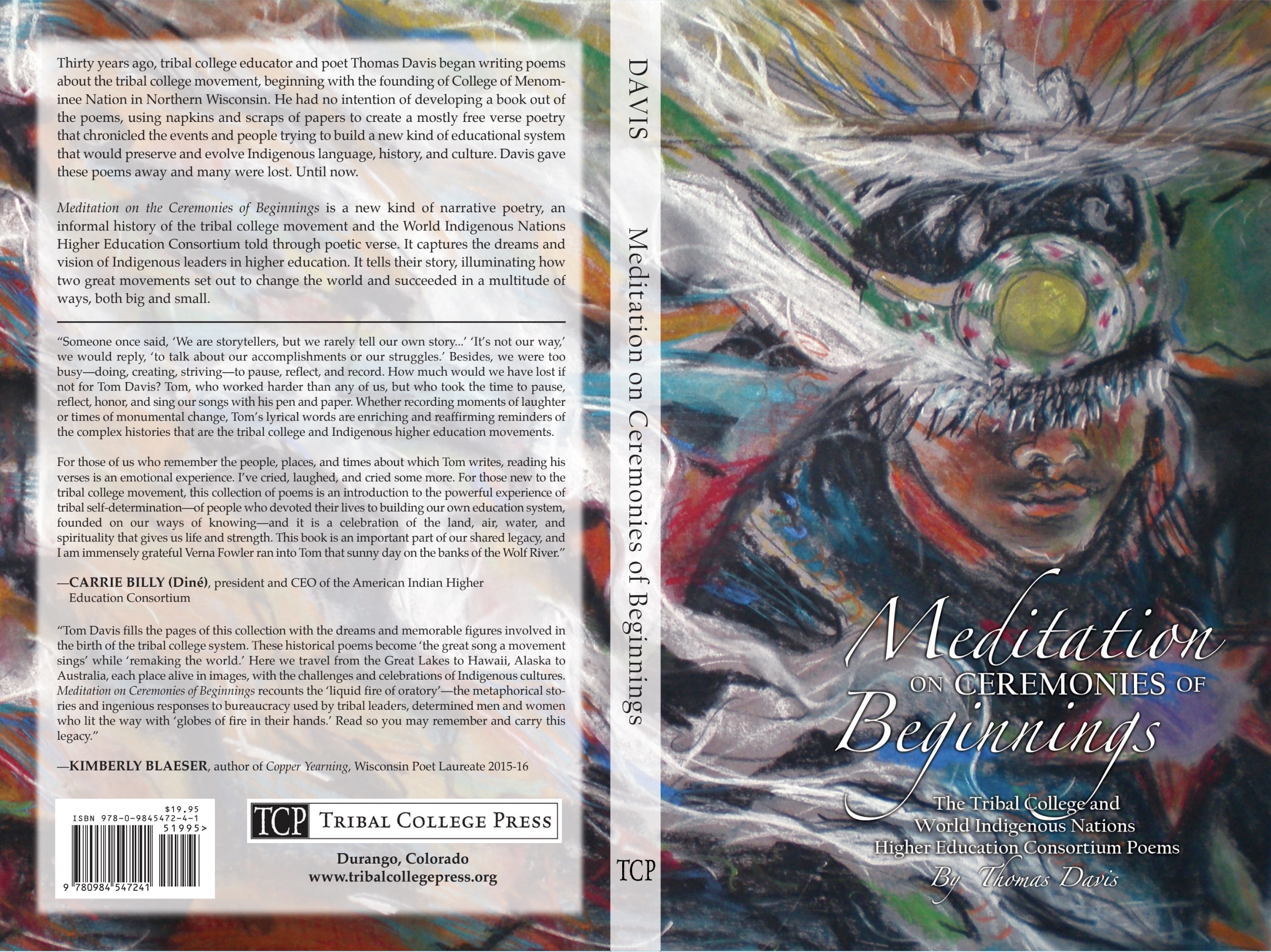
Meditations on the Ceremonies of Beginnings is a book of poetry developed over decades as I played my small role in the tribal colleges and universities and world indigenous nation’s higher education consortium movements. Tribal College Press has announced it will be released in late November. The cover design just came in! The drawing is by Ethel Mortenson Davis.
You’ll have to enlarge to cover to read the writing, but I am especially excited about what Carrie Billy, one of the great leaders of the tribal college and university movement, and Kimberly Blaeser, on the most important Native American poets in the United States, say about the book.
This last,
fading light
is enough
to carry us
across the field,
across the world,

enough
to lift us
from ourselves,
our mitered lives
in this small changeling
of a disappearing evening.
When we are
desperate
and can’t recognize
the world,
we climb
into words,
grasp letters,
covet paragraphs
to find
smallness.

When we are
desperate
we go to this
small garden
to gather ourselves
in the act of
cleaning away dying plants —
to repeat our worth —
in places we recognize,
like the wounded fox
that crawls
into the small culvert.
The Door County Poets Collective has released its newest book, Halfway to the North Pole! A unique poetry anthology, it’s available at Sturgeon Bay’s bookstores and through either Write On Door County or fourwindowspress1.com. It is published by Four Windows Press, the small publishing company Ethel and I own.
There are a lot of Door County’s most important poets represented in the book as well as other poets that have been loyal visitors over the years. Estella Lauter, the instigator of the Collective, in her “Preface” describes the theme of the anthology: “We hope these poems, while providing some anchors in parts of the County you know, will introduce you to places, people, and issues you haven’t noticed and might want to know better on your own: places like Mud Lake, Three Springs, Bjorklunden, Mojo Rosa’s; people like Increase Claflin or Norbert Blei; efforts to bring back the Monarch Butterflies, preserve the night sky, cut or treat infected ash trees, keep the Boreal forest. Door County is not only a beautiful place where culture and nature support each other; it is also a complex community of people and other creatures who come together to care for the land and water that sustain our lives in all seasons. Halfway between the hottest and coldest places on earth, we like to think we have the best of both.”
A baby wren
came to sit
in the burning bush
to show me
she has grown
into a strong bird.
With graceful gratitude
she came to show me
light in my dark world —

just as a matched pair of horses
pulled John Lewis
across the Edmund Pettus Bridge,
so he can be a light
in our black world
just one more time.
Doors at Chaco Canyon photograph by Kevin Davis (2/16/1982 – 7/21/2010)
“The Framing” a poem by Richard Brenneman
This is the anniversary of our son’s death in Poughkeepsie, New York from cancer ten years ago. This is always a sad day for Ethel, I, and our daughters, Sonja Bingen and Mary Wood, every year. This blog was started in honor of Kevin, who was a wonderful web designer, photographer, artist, and poet. This year we are publishing one of Kevin’s most iconic photographs, a doorway found at the Chaco Canyon ruins in New Mexico, and Richard Brenneman’s wonderful poem about the photograph, remembering someone who was deeply, deeply loved.
THE FRAMING
by Richard Brenneman
Ekaphrastic poem celebrating the Kevin Davis photograph, “Doors at Chaco Canyon”
 I

Picture this --
seen through the lens of a camera;
eye sighting perfectly this line of sight,
image remaining after.
The photographer has entered into
this, his picture.

A framing frames the ancient remains,
frame within frame like stone ghosts
from the living to the not living.

II

During the day, the doors,
like sideways viewed Chinese boxes, point the way
to the sky, or a blank wall
where the lords of death
(or alternatively, the lords of life)
are lodged beyond, whether
in kiva, hogan, teepee,
pyramid -- the mountain of gods.

III

At night invisible,
you can barely see the framed gates.
Above, the moonlight,
a few stars shine bright:
Polaris, Sirius, Aldebaran.
The gods of old-time
have come for you --
you who framed this image.
Time into framing,
gate, window, doorway --
starlight seeps out
light from unseen life
in sunrise or twilight,
you who sighted this
in your view finder.

IV

If we look at this image askew,
we can almost see you as shadow,
invisible among
the dust motes, the whirling dervishes
slipping through the frame of time,
the ancient gateways
to join the lords of life, of death
to ascend timeless, bodiless
to the stars,
to become framed
as infinite starshine.
At dawn
a loud crash
sounded against the house.
A flicker lay struggling
on the ground,
his life ending.

A beautiful bird
with speckled chest,
yellow tail,
and red feathers
on his head
looked as though
his spine was broken.

I put him in a quiet
part of the garden.
His weak cries were fearful.

Later that day,
when I checked,
he seemed closer to death.

The next morning
when I went to collect him,
he was gone.

I want to think
he got up and flew
up to the top of my tree,
but probably a cat or fox
found him on their trek
across the country.



 fourwindowspress