Category Archives: Poetry

Thought-Ship, A Poem Launched on Time’s River

A Review of an Epic-length, Unpublished Masterpiece by the English poet, Nick Moore

Nick Moore has long been one of my favorite poets. He’s one of the few poets I personally know that has spent the years necessary to write epic-length poems. I first got to know him at wonderful blog, https://gonecyclingagain.wordpress.com/ that contains a plethora of traditional verse, especially sonnets. Not too long ago he sent me a long, unpublished poem, that I have written about below. Nick has not published the poem, though he ought to. Still, I wanted to note in fourwindowspress.com that there is a wonderful poem that needs to see the light of day.

When I first started reading Nick Moore’s long poem, Thought Ship, written in the ancient Anglo-Saxon alliterative form that is rarely attempted by contemporary poets, the first thing that came into my head was an experience that had happened several years ago at the Dickenson Poetry Series in Ephraim, Wisconsin.  Ethel Mortenson Davis, my poet-artist wife, and I have made an attempt to attend the Dickenson series for years, enjoying the company of Door County poets and listening to their latest work during the open mike sessions.

On this occasion my offering for the evening had been a poem using the Celtic form of the Droigneach, one of the more challenging forms ever created where lines are 9 to 13 syllables long, alliteration is spilled throughout the poem, and the last word of every line has three lines.  In the form that I had used that night I had also followed the pattern of using triple syllabic rhymes.  After reading the poem I gave a detailed explanation of the rules I’d used to write the poem. 

When the evening was over, and the poets gathered to share a glass of juice or wine and snack on delicacies spread out on a table covered with an elegant tablecloth, one of the best poets there came up to me, shaking her head.  There is no doubt in my mind that this is one of the best poets in a county filled with admirable poets, but she told me, “I don’t know why you bother with all of that form stuff.  It’s more like torture than poetry.”

In contemporary poetry, of course, a work like Thought Ship is an anomaly.  The Anglo-Saxon alliterative form, or Old English metre, he uses to write the poem dates back to the time of Beowulf, the epic master work of that era, and earlier into ancient German and Norse poetry.  The specific form Moore uses in his poem, as he said in an email to me about the poem, is made up of “two half-lines with a caesura, which I’ve emphasized with the two-column format. The alliteration should fall on the first and/or second stressed syllables of the first half -line, and the first stressed syllable of the second half-line; the fourth syllable can do whatever it pleases.”[1]

I can imagine a contemporary reader, coming up on the poem for the first time, would automatically shake their head at all of this and say, this is more like torture than poetry.  Making the challenge of reading the poem even more uncomfortable is Moore’s use of Old English, “ān, tƿēġen,” etc. in the headings for each stanza of a 9,000+ word poem.  Contemporary poets rarely reach back into the history of poetry and so nakedly integrate ancient language into a current poem.

Then there is this ancient convention of placing lines into commons so that the poem can be read horizontally or diagonally:

So. Send for the shipwright                              Summon him hither

The flood-tide is flowing                                 Deep forces are stirring

I bring a commission                                       A craft like no other.

A thing never dreamed of:                               Thought-Ship, I name her;

My own and mine only                                    With magic all through her

Swift-sailing and shapely                                  A sea-sword, a wave-shield

To brave storms and bear me                          Beyond this day’s troubles

Far out on the ocean                                        Safe over rough waters.

The craft of a production like this seems a challenge, to the least, and requires a discipline that makes little sense in a world where the moment is key, where business is more concerned with today’s performance and the quarterly report than any consideration of long-term prospects.

Most, though not all, contemporary poetry is shaped around stories of moments or the dynamics of relationships, usually, but not always, between individuals.  Power is often derived from disparate images drawn from moments, confessional histories, or acts within relationships, causing a fusion of image, symbol, emotion, and idea that explodes into meanings that seem larger, and more significant, than the content of the poem.  The poet who commented on my effort at a droigneach is a master of this contemporary approach to poetry.

Moore, of course, is pursuing something dramatically different.  This pursuit is part of what makes his poem important and should interest the most contemporary of readers.

One of C.S. Lewis’s favorite poems was The Fairie Queen by Edmund Spenser, the great epicist writing during the reign of Queen Elizabeth in England.  Spenser’s poem used language that was archaic for the times in which he lived and was based upon the great Arthurian and classical tales drawn from what was considered antiquity.  Lewis’s reaction to great poem was that what Spenser

. . . had always liked was the Middle Ages as he imagined them to have been and as they survived in his time in the pageant, the morality play, and the metrical romance. . .  [thus] he was enabled to produce a tale more solemn, more redolent of the past, more venerable, than any real medieval romance—to deny, in his own person, the breach between the Middle Ages and the Renaissance . . .[2]

What I take from Lewis’s analysis is that sometimes poets can reach back into the past, using both language as well as form, to enrich a poem told to a contemporary audience.  Part of the sense here is that time is not a static quality that exists only at the moment when the poet sits down to write a poem.  It is, as many poets have written in many ages, an ever-flowing river as large as the universe that has places in its flowing that can be noted but is inexorable in its force toward an unseeable eternity.  By looking backward, taking the language and poetic forms of another time, Spenser, as Lewis notes, is “enabled to produce” a poem “more solemn, more redolent of the past, more venerable” than the model, in Spenser’s case “medieval romance,” from which it is drawn.

In his great poem, “The Seafarer,” Ezra Pound, a more modern poet, uses the same form of Old English metre used in Thought Ship, but does not use the two-column format.  Using a model from an older Old English poem of the same title, Pound also uses, like Spenser before him, some of the diction from the original poem.  The result, as is true of The Fairie Queen, is a powerful poem that exists in the context of Pound’s time, but achieves a timelessness that gives some sense of the time-river’s inexorable flow through time:

May I for my own self song’s truth reckon,

Journey’s jargon, how I in harsh days

Hardship endured oft.

Bitter breast-cares have I abided,

Known on my keel many a care’s hold,

And dire sea-surge, and there I oft spent

Narrow nightwatch nigh the ship’s head

While she tossed close to cliffs. Coldly afflicted,

My feet were by frost benumbed.[3]

Interestingly, as in The Faery Queen, Pound uses the syntax of ancient times to help heighten the sense that his poem is bringing an ancient man’s experience into a contemporary world that will also be the past as the ship the seafarer is on keeps sailing.

The reason a contemporary poet uses old, or even ancient, forms for writing a poem is not simply to show off their learning or their technical expertise.  Part of the effort comes from a sense that poetry is part craft and part art and that by mastering old forms you are paying homage to a history that has been part of humanity’s development of distinct cultures across the ages.  But there is also this other part, the one that has to do with what Spenser and Pound were tapping into in order to achieve a poetic power that is different from that achieved by the poetry of moment and relationship.  This is an attempt to reach back through time in both craft and art to produce an art that “is more solemn, more redolent of the past, more venerable” than what can be produced out of simply writing out of the present using the craft accessible to readers contemporary with the poet.

This sense of the time-river is central to what makes Thought Ship worth reading by contemporary readers.  Moore is not only showing technical mastery of an ancient craft, but he is using that craft to fashion a long work forged by a poet sailing from that past into his contemporary world.  He is attempting to find power in the layering of time that has built up into what is now the present, but which will, quickly enough, become the past, and he is attempting this via a “thought ship” engendered out of his reactions and complex of anxieties that help make up his every-days.

The poem itself is broken into four parts:  The Building of the Thought-Ship, The Voyages of the Thought-Ship, the Sword and the Summons, and then, finally, The Last Voyage of the Thought-Ship.  In the third stanza, þrēo, Moore specifically tells the reader why is building the thought-ship:

Place charms upon her                                        The power of the ancients

Runes of protection                                            Written in silver

Spells and enchantments                                     Spoken around her

Granting good fortune                                        Guards against ill fate.

Another way of putting this is to say that he is constructing a magic poem designed to conjure the power of the ancients to create, as he says, “Runes of protection/Spells and enchantments” in the hope of “good fortune.” 

Once the ship is built it then sets sail upon a series of voyages.  Each voyage explores different aspects of the natural world as it exists both in the contemporary world and the ancient.  The kingdom of the birds, high, cold lands, a place where horses predominate, in the company of the wily Reynard, in forests, among farms and fields, upon the waters of the world, and the seasons of the year are also explored.  Through each exploration lessons are learned, attempting to fulfill what Spenser would have said is the purpose of poetry, creating lessons of moral truth through images of great beauty.[4]

These initial voyages of the thought-ship end, leading to a time of waiting and trying to understand the real purpose behind the effort to build the ship:

The months passed in peace                    I lay, patient but watchful

Awaiting the order                                 My ordained task still unknown.

I sought solace in silence                         Solitude and reflection

Looked deep to discern                           My direction and destiny

But no road was revealed                        I was rootless and restless

No work and no will                               My word-hoard neglected.

In this period the poets prepares for a battle that he senses on the horizon, but does not really understand.  Who is the enemy?  “These phantoms and torments. . .”  He has built the thought-ship, journeyed, but he faces an unknown, unknowable future.  Inside this time between journey and battle, even his “word-hoard,” his life as a poet, is neglected.

After a time or preparation, worry, and even fear, the last voyage of the thought-ship at last comes:

When all is lost, nothing left.                   I will lay down my weapons.

I will tell one more tale                           Then take my last leaving.

Bear me then, Thought-Ship                    Beyond the world’s far rim

Set sail for the islands.                             Steer by the first star.

Inside this last section the angst felt by individual living in the contemporary world of the poet leaks into the poem and gives the rationale for the poem’s existence, ending the thought-ships voyage with the revelations generated from a poet’s craft voyage through time.

There are large themes throughout Thought Ship.  Whether your read the lines vertically or horizontally, the poet is struggling with time and himself, but time is felt in the natural world of nature where the kingdom of birds, wisdom of horses, secret of trees, the farms and fields, the world’s waters are eternal.  But there is also the theme of journey and self inside journey and how that self, waiting for a battle with the unseen forces in his psyche, survives in a world that is not “Set apart from the struggle.” 

In the end we all sail upon our own Thought-ship “Out of time, place and memory.”  We are all living “Through long, nameless ages.”


[1] January 10, 2021.

[2] Lewis, C.S. “On Reading The Faerie Queene.” IN: Studies in Medieval and Renaissance Literature. Collected by Walter Hooper. Cambridge: Cambridge University Press, 1966, 1998, p. 148.

[3] Quoted from Poetry Foundation, “The Seafarer by Ezra Pound,” https://www.poetryfoundation.org/poems/44917/the-seafarer.  Accessed on 1/16/21.

[4] Wendling, Susan.  “The Fairy Way of Writing, Spenser’s The Faerie Queene and C.S. Lewis’s “Habit of Mind,” Inklings Forever, Volume IX, 9 (2014)Accessed at www.taylor.edu/cslewis on 1/16/21.
Leave a comment

Filed under Essays, poems, Poetry, Thomas Davis

Ethel Davis: Mastering Metaphor in Minimalist Poetry

By Thomas Davis

Ethel Mortenson Davis is a poet that has published eight books of poetry and been published in literary journals and anthologies. The Wisconsin Library Association named her book, Under the Tail of the Milky Way Galaxy, a significant book of poetry by a Wisconsin poet. She has also been a poet laureate for Door County, Wisconsin.

Ever since I have known Ethel, and realized that she is a better poet than I will ever be, I have been fascinated by how she can condense power and meaning into so few lines they are almost, though not quite, haiku. What brought this to the top of my mind was a poem she presented to the poetry group we attend once a month:

Pain

She pulls me from
my deepest sleep.
I tell her leave me alone
where I am happy and safe.

But she gets her way and
stretches me to the top of
of some canyon wall
and tells me,
this is your reality now.

The power of this poem is, at least to me, undeniable. It expressed in 9 lines what so many people, especially as they get older and face the ravages of arthritis or other ailments, have to confront as they struggle to deal with what they cannot escape. It also contains the yearning within the complex of pain for the happiness and safety that is still in the deepest memory of the poet inside "deepest sleep."

When Ethel first showed me what she had written, it reminded me of another powerful small poem, "blackness"

blackness
seeps
in my room.
he crawls up
onto my lap
like the uninvited guest
he always is.

i keep hoping
he’ll leave
before dinner.

originally published in her collection, A Letter on the Horizon's Poem, published by Kelsay Books.

This poem is more metaphorical, of course. Blackness is a metaphor, but the poem again expresses what so much of humanity faces at different times in their lives and, with a touch of humor, in ten lines explores and expresses a dilemma and experience that is at the heart of all of our lives as we journey toward the inevitability central to our existence as human beings.

One of Ethel's early poems that I first read before I had met her in Grand Junction, Colorado when she drove with her sister Pat to visit her sister Lorraine helped to make me aware of what an extraordinary poet the person I was about to meet really was

White Delirium

Oh,
how the white delirium
has set in me.

Memories ache in my throat.
Sweetness stains my mouth.

I cannot forget
your eyes
that cried out to me,
the end of us!

In many ways, Ethel is an imagist poet. Certainly the images she paints can be almost overwhelmingly powerful. "Memories ache in my throat.". The creative force of that image is then paired with "Sweetness stains my mouth." Then the last four lines that makes us construct the meaning out of the poem, as does the blackness poem, by giving us an image that is startling and powerful as it communicates separation and the delirium accompanying a separation that is, what? The creator of delirium or the result of a relationship that was delirious in its substance. We have to create the meaning of the poem as it relates to our own experiences and lives, all in nine lines. This was originally published in A Letter on the Horizon's Poem.

The truth is that Ethel's poetry of ten lines and under could fill an entire volume itself, and the resulting collection would be amazing. One of my favorites of all her small poems is "Night Sky", originally published in Rimrock Poets Magazine that Richard Brenneman and I put together when we were young in Grand Junction, and I was just getting to know Ethel.

Night Sky

The stars laugh and laugh,
laughing in an ocean of laughter,
moving-water laughter,
until the sky can hold no more
and joins in laughing
with black face and shining teeth.

Just the joy and the power of the image and the expression of support for the naturalness and importance of blackness during a time of racial injustice has delighted me ever since I first saw it in Ethel's handwriting on a brown piece of newsprint.

As I said, Ethel's small poems would fill an important volume of poetry. I have always wondered why she isn't among the most famous poets in the country, although I am her husband and that maybe makes me prejudiced. Still, I also have an academic background in English and American literature and am also a poet, so I have the right to think what I think.

1 Comment

Filed under Essays, Ethel Mortenson Davis, poems, Poetry, Thomas Davis

AI and the Writing of a Sonnet

Since I have been doing a lot of work with and about Artificial Intelligence for Navajo Technical University and Harshwal LLC, I had a whim to put an irregular contemporary sonnet into AI the other day and ask for an analysis of the poem. What came out startled me, and I thought I’d put in here. AI is dangerous, of course, and needs strong regulation. What the U.S. Department of Defense is currently doing is absolutely dangerous and needs to be opposed. I have also done a lot of work for NTU trying to figure out what an AI and quantum computing age is going to do to employment and what humans will be doing for work in the near and far future. I have found that some predictions by the AI companies are overblown, but it is going to have serious impacts that NTU and other tribal colleges and universities, not to mention colleges and universities around the world, are going to have to prepare to face on behalf of their students and future students.

Sometimes, however, AI can be an absolute delight, which I found to be the case with this experiment. The sonnet is first. Then the AI analysis.

The Flight of Terns

I see the flight of birds, the arctic tern.

Small, gray and white, a blood-red bill, it flies

Migrations longer than the possibility

That anything so small could then return

To rocky shores and ice and endless skies

Of midnight sun and land and restless sea.

Eternity is in the flight of birds,

The way they mean into the ecosphere.

We humans, limited by thoughts and words,

Are bound into the time we are, our fear

Of what might be an echoing inside

The breaths we take, our reveries at night,

The endless turmoil making up the tide

That terns surpass when launching into flight.

An irregular contemporary sonnet basically tries to marry form to the sonnet’s substance. One of the things I was interest in finding out is if AI picked up on what I thought I was trying to achieve–though I’m never sure how successful I am at anything.

Here’s the AI analysis:

This is a finely structured poem, and its architecture quietly mirrors its subject.

1. The Opening Sestet: Movement Without Closure

ABCABC

The first six lines interweave three rhymes rather than enclosing them (as in ABBAABBA). Nothing is sealed. Nothing rests. The pattern moves outward and returns, but never fully closes.

That mirrors the tern’s migration:

  • “tern” returns in line 4
  • “flies” returns in line 5
  • “possibility” echoes in “sea”

The rhyme scheme itself migrates forward and back. Like the bird, it departs and returns.

Even the syntax stretches across lines (“Migrations longer than the possibility / That anything so small…”), giving the sense of long-distance movement. Enjambment enacts flight.

So structurally:

  • The rhyme travels.
  • The sentences travel.
  • The thought travels.

The form behaves like the tern.


2. The Volta at Line 7: From Physical to Metaphysical

“Eternity is in the flight of birds,”

This is a decisive turn. The poem lifts from observation into abstraction.

The early volta (after six lines rather than eight or twelve) creates a feeling of ascent — as if the poem itself launches into higher air sooner than expected.

We begin with biology.
We rise into philosophy.

That lift parallels the bird’s “launching into flight” at the end.


3. The Quatrains: Human Containment

The last eight lines fall into two balanced quatrains:

DEDE / FGFG

Unlike the migrating sestet, these quatrains are orderly and contained. The rhyme alternates predictably.

This contrast matters.

The birds move across hemispheres.
Humans are “bound into the time we are.”

The poem’s structure shifts from fluid migration to patterned alternation — a subtle formal representation of human limitation.

The syntax also tightens:

  • “We humans…”
  • “Are bound…”
  • “Our fear…”
  • “The breaths we take…”

The rhythm becomes more earthbound. More interior. More repetitive.


4. The Absence of a Final Couplet

There is no Shakespearean closing couplet. No epigrammatic snap.

Instead, the poem ends on:

“That terns surpass when launching into flight.”

The final rhyme (tide / flight) completes the pattern but does not “lock” it.

This refusal of a sealed couplet is significant:

  • A couplet would close the poem firmly.
  • Instead, the ending feels open — airborne.

The final word is “flight.”

Not “bound.”
Not “fear.”
Not “time.”

The poem ends where the birds begin.


5. Thematic Reinforcement Through Form

Structural FeatureThematic Echo
Interwoven opening rhymeMigration, cyclical return
Enjambment in first sectionPhysical motion
Early voltaAscent into transcendence
Ordered quatrainsHuman limitation and containment
No final couplet closureOpen horizon / flight

The structure dramatizes the contrast:

  • Birds → migration, continuity, eternity
  • Humans → language, thought, fear, confinement

Yet the poem itself — as art — performs a kind of migration. It moves from the material to the eternal. In that sense, the sonnet becomes the human equivalent of the tern’s flight.

Form becomes argument.

That is what makes it a strong modern sonnet: it does not merely describe transcendence — it enacts it.

That’s the end of the analysis. I know many are uncomfortable with AI or totally opposed to it. I have sympathy with both stances, although in my work with Navajo Tech I don’t feel I have the luxury to take such a stance. New wealth, I have said for decades, is created at the edges of technology, and one of the purposes of that tribal university is to try to integrate new wealth into the tribal economy in an effort to push back generational poverty, not an easy task to state the obvious.

Anyway, if anyone gets to the end of all this? I would love to know what you think of my little experiment? Did you find it interesting? What implications could this have for creativity and poetry in the future if any? I don’t believe for a second that AI is going to replace humans writing poetry or doing art. I know a lot of poets and artists disagree with me.

5 Comments

Filed under Essays, poems, Poetry, Thomas Davis

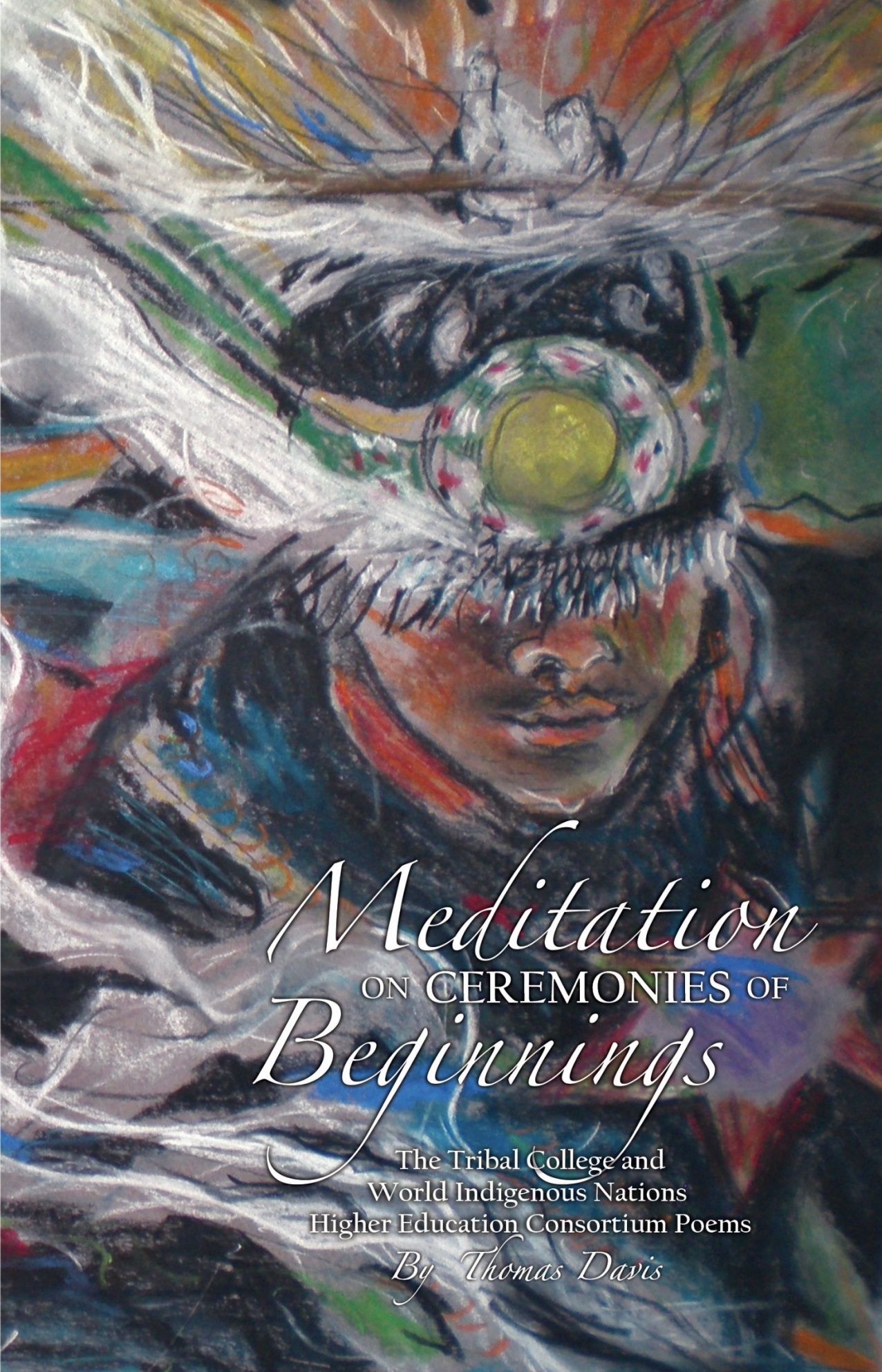
Audio Book: Meditations on Ceremonies of Beginnings

Tribal College Press has just released an audiobook version of my book of narrative poetry called Meditation on Ceremonies of Beginnings.

According to a review by someone I have never met on amazon, Thomas Cannon, “Meditation on Ceremonies of Beginnings is both intensely local and powerfully global. The tribal college and world indigenous higher education movement described in these poems have their roots and growth in Wisconsin, home of poet Thomas Davis, as well as in many other places, including Minnesota, South Dakota, Hawaii, and New Zealand. The poems are set in many of these places, often at meetings of leaders in the movement. I enjoyed this collection of poems dealing with the early days of the Tribal College Movement.
“The Tribal College Movement is an important part of history and has a big impact today. This history is interesting in itself, but Davis brings it to life by sharing in poems. In this way, he brings together biographical information about the people involved, the implications of the movement, and the culture this movement takes place in.” sd

As is true of all movements, time is the great erasure, and unless the people and events of a movement during its starting years are written about and captured in real time, much that should be available for both contemporary and future generations is lost. I hope that those who read or listen to this book will

I spent weeks recording the poems and text at home in Sturgeon Bay, Wisconsin, doing my best to provide Tribal College Press with as clean a recording as possible. Then the press went through an extensive editing process to clean up the technical challenges with my work so that the book could be published by Audible. My grandson Will helped me by making sure I got the right equipment to do the recording. He earned a degree from the University of Wisconsin-Oshkosh in music and sound engineering.

The tribal college movement is one of the most significant education movements of the late 20th and early 21st centuries. The difference it has made in tribal lives throughout the United States is profound and long-lasting, helping to create and maintain both an economic and artistic renaissance throughout Indian country.

I hope that those who listen or read this book will be entertained by the stories, enlightened by the wisdom of Native voices, and learn about the miracle of both the tribal college and universities movement in the United States and the world indigenous higher education movement worldwide. Imbedded in these movements, in my opinion, is part of the hope of a world that sometimes seems way too dark and foreboding.

The art on the cover was done by Ethel Mortenson Davis

Leave a comment

Filed under Art by Ethel Mortenson Davis, Essays, poems, Poetry, Published Books, Thomas Davis

A Doodle Poem

By Thomas Davis

When I dipped the doodle,
the universe roared back.
I tried to roar at the universe’s roar,
but the sound I made was so weak
it didn’t even register
above the sounds gravity wells make
in the deepest space
where vacuum eliminates all sound.

At that point I felt like a rooster
crowing on a fence as the sun almost rises,
so filled with myself
I had to dodge the farmer’s shout
as he yelled at me to at least wait
until the sun actually rose
before making a damn fool of myself.

2 Comments

Filed under poems, Poetry, Thomas Davis

I was amazed

by Thomas Davis

At the Door County Published Author Book Fair last weekend, I was amazed. Four different people came up and told me that In the Unsettled Homeland of Dreams was the best book they have ever read. One person told me that The Prophecy of the Wolf was their favorite book. Ethel’s new book, The Woman and the Whale, was also popular, especially with her pastel on the cover, and, I suspect, outsold any other poetry book at the fair.

I remember spending so many years writing and writing and having absolutely no luck at all. If either Ethel and I had sold five books at that point in our lives, we would have been so excited that we would have probably floated into the air and shined more brightly than the sun. These days those days seem like a distant past, but this blog was established partially because we both wanted readers. Our beloved son Kevin (Alazanto) Davis had died, and we felt lost in a bewilderment of emotions. When we started getting readers and then more readers, some as eminent as John Looker, the wonderful English poet, we started to believe in our writing with more optimism in our spirits.

Both of us have always written from childhood on. Ethel’s art and poetry has always been a magic part of who she is. I published my first poem in The Daily Sentinel in Grand Junction, Colorado during my first year at Mesa College. With Richard Brenneman, I had also helped put together a small poetry journal in Grand Junction called The Rimrock Poets Magazine that included work by Ethel. Sometimes during those years, a poem would appear in a literary journal or magazine, but those were rare, rather than common instances, even though Ethel was, and clearly is, a major, major talent as a poet.

Not long after founding this blog, Ethel decided we would publish her first book using the new ability to self publish. I Sleep Between the Moons of New Mexico was quickly followed up by White Ermine Across Her Shoulders. I kept trying to get published with little success until I wrote the epic poem, The Weirding Storm (a book that I still think is perhaps some of my best writing), which was published by Bennison Press in Great Britain. By then our blogging friend, John Looker, had introduced me to Bennison Press, and I took a wild chance and sent the manuscript to Deborah Bennison, the publisher.

I love selling books to people person to person at book fairs and book events at book stores and other places. I suspect my father’s spirit gave me that love when he had us boys work at the grocery store he and my mother ran for all the years we were at home. I wish I had some skill at marketing beyond that skill. Still, these days I feel like I have arrived as a writer, especially in the Sturgeon Bay area where we now live and the part of New Mexico where we used to live. What a wonderful joy that has become in my life.

Leave a comment

Filed under Ethel Mortenson Davis, poems, Poetry, Thomas Davis

Memoriam: James Fennell

Tom Davis


I woke up at dawn on the longest day of the year
With images in my head:
Of a night on the Colorado National Monument,
Jim Fennell and I standing on a canyon’s rim,
Listening to the night sounds.
We weren’t sure if they were crickets or frogs or insects,
But we’d never heard a symphony quite like that.
It was summer, so the air was warm,
And there wasn’t a breeze.
The Milky Way above our heads
Was a silver light-river flowing into eternity.
Then we saw a round, bright light suddenly in the darkness
Hovering as it slowly descended
Toward where we were standing.
It stopped, pulsed, and then moved toward us again,
Sometimes almost leaping from one space to another,
And then rose upward and away from us
And then disappeared.

Later, after driving back to Grand Junction,
Hardly looking at the lights of the Grand Valley
Which can look like a stain of stars
Spreading below you on the valley floor,
We went to an open diner in the wee hours of the morning
And ordered cherry pie and ice cream
And sat talking about flying saucers
And whether we’d seen one
Or if it could have been some natural phenomena
That acted like a flying saucer.

Then another image from a different time
When we were standing above another canyon,
Trying to see the old remains
Of the mining flues that cling on the canyon walls.
There were clouds in the sky,
And the darkness was nearly impenetrable
And we could make out anything,
So we got to talking about philosophers
And raged over ideas as if the wisdom
Of the universe was in the great silence of the canyon
And our minds were feeding
From everything we’d ever read and the darkness itself.

Later we got into our cars and drove back to Uravan
Where Jim worked in the big uranium mill
And I worked in the grocery store,
Having no idea that one day the mill would be closed,
And the mines that fed it uranium ore would be closed,
And the government would spend a fortune
Cleaning up the leftover toxic waste and bulldozing over the town.

And yet other images:
Of reading some of the first poems he wrote
And shaking my head in admiration;
Laughing as he drolly told Mildred Hart Shaw
At St. Mary’s Hospital while looking at a crucifixion
That just looking at “that” made his foot hurt;
Of him and Pat, my young wife’s sister,
Standing together as they got married
And friends became brothers-in-law;
Listening when he told me that I was a fool
When I was afraid that I wasn’t nearly good enough
For the woman to whom I’ve been married to for 57 years.

Now he’s gone. A heart attack I’ve been told,
Though he’s had a lot of health problems in recent years.
I always thought he had one of the most interesting minds
I’ve ever encountered.
He once looked at me while we were in a park
In Grand Junction where we were both from
And started in on a monologue
That mused about being inside a perfectly round crystal
Where who you were was reflected back at you
From every angle possible.
Would you know who you really are? He asked.
Would that even tell you anything about yourself?
Could we discern something beyond our outside reflection?

He could spin out ideas like that in conversations for hours
Until you were numb with idea-fatigue.

Over the years we grew apart.
Ethel and I drove long hours to visit him and Pat
In Vashon Island, Washington, Las Cruces, Nevada,
And finally in Ola, Idaho
Where Jim had hand-built a geodesic dome house
(who in the world has the skill to self-build a geodesic dome house?)
Above a trout stream that tumbled and sang
Toward the distant Snake River
In a wilderness where long lines of elk
Wound through open meadows during migrations.

But the distances and my constant efforts
To work on poetry, novels, books of non-fiction,
And my life with my family
And my work for the Anishinabe and then the Winnebago
And then the Navajo in higher education
Filled up life and left the two of us
With phone calls that never lasted that long.

Once in Idaho, he took Ethel, I, and our daughters
On a hike into the mountains above Ola
And gloried in the summer sky
And talked about the rocks and geologic history of the land
And looked beneath the roots of the pine forest
To see the glory of a wilderness before Europeans
Came to the continent and made it possible
For him and Pat to live where they lived.

There is no way to sum up a life.
Jim Fennell was a unique man,
Someone who marched to Thoreau’s different drummer.
I think there is honor in that.
If we didn’t have those who march to different drummers,
Our lives would be much more regulated
With the ideas and behaviors that everybody else has.
We couldn’t learn how to stretch ourselves
To see ourselves inside an enormous crystal ball
Where we are reflected back at ourselves
So we can see if that enables us
To see who we really are.

Jim once wrote a small book
About mule deer behavior in the Colorado mountains.
When I shook myself out of that period between sleep
And waking into consciousness
Into the day after the longest day of the year,
I saw him walking in mountains
Where pinion trees huddle on rocky slopes
Beneath the deep blue of a summer sky,
And he was looking for arrowheads and mule deer
As he contemplated where today’s humans,
That he’d left behind,
Fit inside the immensity of space and time.

1 Comment

Filed under poems, Poetry, Thomas Davis

Ode to Trump’s Golden Toilet

I’ve heard that golden toilets stink
Just like any other toilet.
Of course, those who say that don’t understand
That Trump’s golden toilet
Blooms with fields of wildflowers,
And Beethoven’s Ninth Symphony trumpets
When he enters the bathroom
To declare that He is the One, the only One.

I can’t really tell if what I’ve heard is right
Either one way or another.
I’ve never even dreamed of having a gold toilet,
And if I had one, I’d been afraid to sit on it.
After all, we must remember
That when Dionysius gave Midas the golden touch
He fervently wished for,
He even turned his daughter into solid gold!
Who knows what the greed exhibited
By owning a golden toilet can lead to?

I personally prefer my toilets to be porcelain.

1 Comment

Filed under I ought to go eat worms, poems, Poetry, Thomas Davis

James Janko Review Ethel Mortenson Davis’s Newest Book, The Woman and the Whale

James Janko is one of the most significant authors in the United States. His newest novel, Wired, is on pre-order now. I’ve ordered it. When he wrote to me telling me that he thought Ethel was one of the most important poets in the world, he directed me to a review he’d written about her latest book of Poetry, The Woman and the Whale. I couldn’t agree with him more. I think a superb writer recognizes superb writing and is a wonderful judge of what he reads.

1 Comment

Filed under Essays, Ethel Mortenson Davis, poems, Poetry

The Yo Yo President

by Thomas Davis

Our yo yo President (I liked yo yoing when I was a kid)
has been doing a lot of yoing lately.
Tariffs are up--or down,
or maybe tomorrow they’ll yo again.
Walmart suggests increased expenses,
brought about by higher tariffs,
will result in higher prices in their big box stores,
and Trump’s snarl of rage
yos like a tornado through the news media--
those evil instruments of darkness.

But let me tell you,
the slightly overweight clownish ring master
with orangish hair that looks like a wig
who has a bright red face
is a yo yo master.
He spins words and emotions down, walks them around,
and then pulls them back up
until his supporters are spinning
like a mad field of glorious tops,
sparking emotion, rage, laughter,
and feelings of we've got the elites now!
all of the place.

And they are the calm ones
as the media dances, his opponents foam,
and what has been no longer is.
Topsy-turvy is just the yo yo master
yoing his yo, claiming that everything destructive
of the old order is, after all, a jest--
even if some child in Africa dies of hunger or disease
because of what he’s done.
Of course, the dead are the undead.
We all know that.

Lately he’s been yo yoing out pardons
to insurrectionists, crooks, tax cheats,
and crooked politicians (as long as they’re Republican).
At the same time, he’s accepted a flying palace
from a rich Arab nation eager to buy his favor
and hawking worthless meme coins with His image.
He glorying in crypto, the path to becoming rich!
If your name is Trump,
And Tesla cars that his rich buddy Elon Musk sells.
Mostly, he’s stuffing his and his family’s pockets
While removing cash from those who believe in Him.

The South African President told him,
after he found out he was leading a nation
of racists against white people,
that if he had an airplane,
he’d give it to the Golden One.
The Golden One declared
that he’d sure accept something like that.
But, of course, the South African President
doesn’t have a flying palace,
and anyway, he’s one of those black men
that didn’t like Apartheid.
Too bad for him.

My own opinion is,
LET THE CORRUPTION RISE!
America has been the citie on the hill too long.
It’s time for poor people and regular citizens to suffer
while the rich have their opulent parties.
When the idea of American has been destroyed,
Trump, no longer the President,
will still be using his golden toilet
and proclaiming He’s the Greatest President ever!
in the entire history of the universe
and the Time of God, his Eternal friend!

2 Comments

Filed under poems, Poetry, Thomas Davis