Tag Archives: tribal colleges and universities

Audio Book: Meditations on Ceremonies of Beginnings

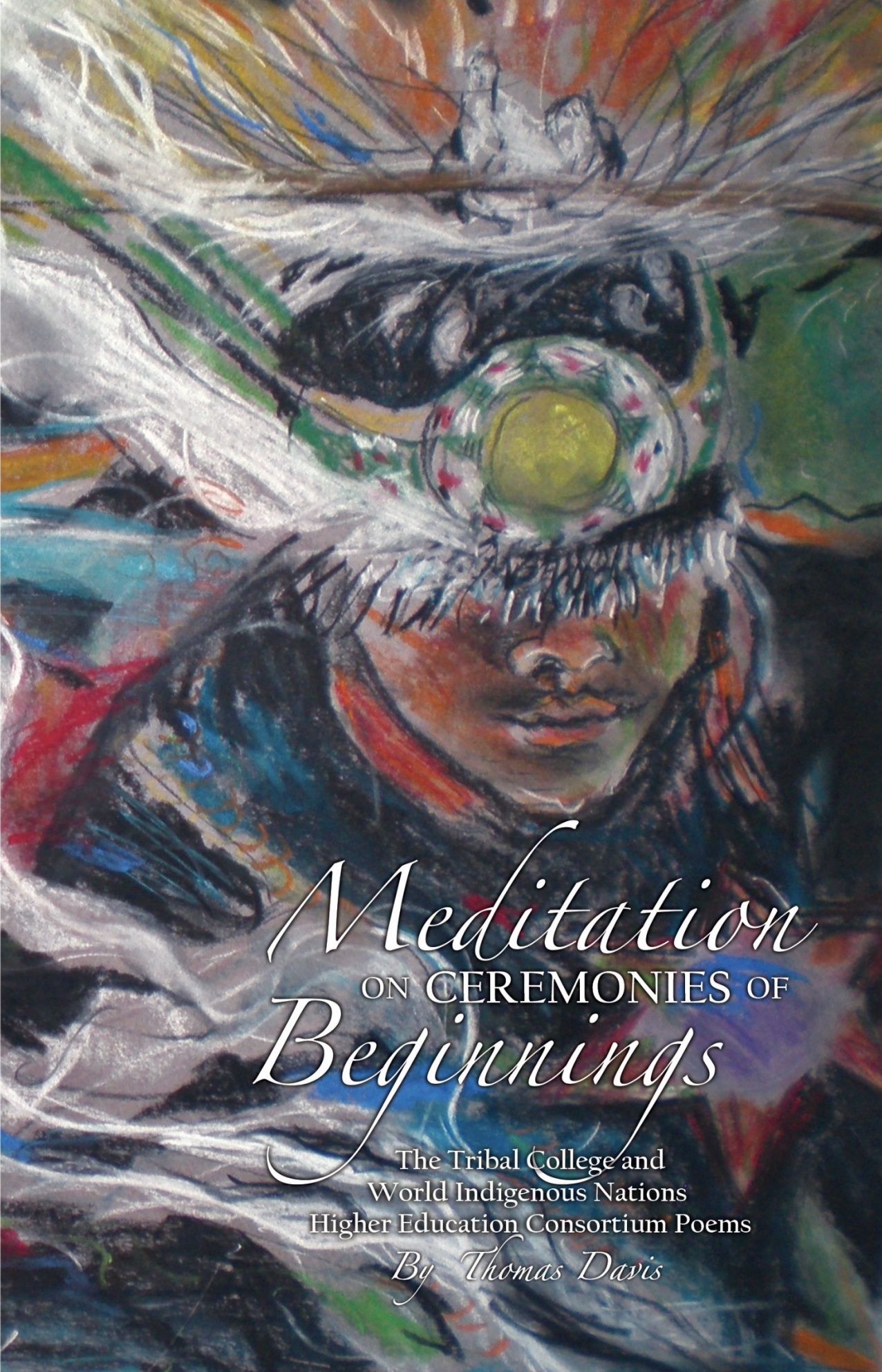
Tribal College Press has just released an audiobook version of my book of narrative poetry called Meditation on Ceremonies of Beginnings.

According to a review by someone I have never met on amazon, Thomas Cannon, “Meditation on Ceremonies of Beginnings is both intensely local and powerfully global. The tribal college and world indigenous higher education movement described in these poems have their roots and growth in Wisconsin, home of poet Thomas Davis, as well as in many other places, including Minnesota, South Dakota, Hawaii, and New Zealand. The poems are set in many of these places, often at meetings of leaders in the movement. I enjoyed this collection of poems dealing with the early days of the Tribal College Movement.
“The Tribal College Movement is an important part of history and has a big impact today. This history is interesting in itself, but Davis brings it to life by sharing in poems. In this way, he brings together biographical information about the people involved, the implications of the movement, and the culture this movement takes place in.” sd

As is true of all movements, time is the great erasure, and unless the people and events of a movement during its starting years are written about and captured in real time, much that should be available for both contemporary and future generations is lost. I hope that those who read or listen to this book will

I spent weeks recording the poems and text at home in Sturgeon Bay, Wisconsin, doing my best to provide Tribal College Press with as clean a recording as possible. Then the press went through an extensive editing process to clean up the technical challenges with my work so that the book could be published by Audible. My grandson Will helped me by making sure I got the right equipment to do the recording. He earned a degree from the University of Wisconsin-Oshkosh in music and sound engineering.

The tribal college movement is one of the most significant education movements of the late 20th and early 21st centuries. The difference it has made in tribal lives throughout the United States is profound and long-lasting, helping to create and maintain both an economic and artistic renaissance throughout Indian country.

I hope that those who listen or read this book will be entertained by the stories, enlightened by the wisdom of Native voices, and learn about the miracle of both the tribal college and universities movement in the United States and the world indigenous higher education movement worldwide. Imbedded in these movements, in my opinion, is part of the hope of a world that sometimes seems way too dark and foreboding.

The art on the cover was done by Ethel Mortenson Davis

Leave a comment

Filed under Art by Ethel Mortenson Davis, Essays, poems, Poetry, Published Books, Thomas Davis

An Honorary Doctorate

I am, at this moment, completely stunned. I understand I was nominated by Dr. Elmer Guy, President of Navajo Technical University and Carrie Billie, the former Executive Director of the American Indian Higher Education Consortium. I cannot thank them and the selection committee at WINU enough.

World Indigenous Nations University

1 October 2025

The Office of the Chancellery

World Indigenous Nations University

winuenquiries@gmail.com

Mr Thomas (Tom) Davis Navajo Technical University

Lowerpoint Road, State Hwy 371 Crownpoint, New Mexico, 87313 Email: tdavis@navajotech.edu

Dear Tom

Re: Recommendation to receive a 2025 WINU Honorary Doctorate – Education (EdD) for Indigenous Education

The World Indigenous Nations University (WINU) was launched in 2014 at Crownpoint, New Mexico, USA, heralding in a new era of Indigenous higher education. The formation of WINU represented the culmination of global consultations with a gathering of First Nations educators, scholars, knowledge holders and Elders over an extensive period to establish a more culturally inclusive and responsive higher education system for their people. An inspiring source of WINU’s formation has been the United Nations Declaration on the Rights of Indigenous Peoples (UNDRIP) and the World Indigenous Nations Higher Education Consortium (WINHEC), which called for critical changes to take place in the engagement of First Nations peoples in higher education.

Every year nominations are called for the WINU Honorary Doctorate Awards. They recognize the meritorious work of Indigenous Educators, Scholars, Knowledge Holders/Elders who their peers and community acknowledge as an inspirational leader. It gives me immense pleasure to advise you that a successful nomination has been received by the WINU International Review Committee nominating you for a 2025 World Indigenous Nations University (WINU) Honorary Doctorate as an outstanding Educator and Knowledge Holder.

The nomination received from Dr Elmer J. Guy and Carrie L. Billy and supported by the Navajo Technical University, acknowledges and honors your contributions as a transformative leader and active participant in the Tribal College movement since the 1990s, in the United States and globally. Carrie’s biographical statement of your achievements provides details of your leadership, advice and expertise that has helped transform Navajo Technical University and several other tribal colleges and universities, through partnerships, research programs, initiatives and new academic programs. Globally, you are recognized as instrumental in the creation of the World Indigenous Nations Higher Education Consortium.

The conferral of the WINU Honorary Doctorate upon you is seen as honoring and profiling your exemplary dedication and contributions through your work at the local, national and global levels. Your nominees seek to celebrate and salute you for the many gains you have made through your meritorious and scholarly contributions, which have advanced Indigenous education through your transformational leadership, diligence and commitment.

The WINU Board of Governors and the International Review Committee have endorsed that the meritorious Award of WINU Honorary Doctorate – Education (EdD) for Indigenous Education, be conferred upon you at this year’s annual WINU Conferral Ceremony, which will be hosted by Te Wananga o Aotearoa, Mangere Campus, Auckland, Aotearoa, New Zealand. This ceremony is an integral part of the WINHEC AGM scheduled for 13-14 November 2025.

The conferral of the WINU Honorary Doctorate upon you pays homage to the pertinence of your work to the Articles of the United Nations Declaration on the Rights of Indigenous Peoples and to the foundational goals and objectives of the World Indigenous Nations Higher Education Consortium (WINHEC) and the World Indigenous Nations University (WINU).

Congratulations on the success of your nomination for this most meritorious Honorary Award.

Accordingly, you are invited to attend this year’s Ceremony at the 2025 WINHEC/WINU Annual General Meeting being hosted by Te Wananga o Aotearoa, Mangere Campus, 15 Canning Crescent, Mangere, Auckland, Aotearoa, New Zealand, where you will be officially conferred with the WINU Honorary Doctorate – Education (EdD) for Indigenous Education.

Unfortunately, WINU cannot assist with travel, accommodation or the WINHEC registration fee. However, should you wish to attend the meetings the registration and accommodation details can be found on the WINHEC website www.winhec.org. Please contact Dr Berice Anning, the Deputy Vice Chancellor WINU via email: winuenquiries@gmail.com to advise if you will be attending the Conferral Ceremony in person.

We look forward to receiving your advice as to whether you wish to accept the 2025 WINU Honorary Doctorate – Education (EdD) for Indigenous Education, and if so, whether you can attend this year’s formal Conferral Ceremony in Aotearoa.

On closing, the WINU Executive again extends to you the sincerest congratulations on the success of your nomination for this most deserving and meritorious honorary award

Professor Boni Robertson     Professor Jolan Hsieh

4 Comments

Filed under Uncategorized

The Miracle of Navajo Technical University

This is my newest book. I put the together with a number of colleagues from Navajo Tech where I was the Provost up until my retirement. Navajo Tech and the 38 tribal colleges and universities (TCUs) are in serious trouble from the budget cuts in Washington DC. Several colleges, like the iconic and irreplaceable Institute of American Indian Arts, is in danger of closing. IAIA has had its budget totally eliminated in the House of Representative budget now going to Congress. The TCUs are one of the greatest innovations in higher education during the late 20th and early 21st century. Losing them is unthinkable.

What I wanted to achieve with this book is to use Navajo Tech as a lens to illustrate just how valuable the tribal colleges are on several levels: To the students they serve, the Native Nations that chartered them, and the United States as whole. The science and technology at Navajo Tech is world class, and its defense of culture and language has led to the creation of the first PhD program by a TCU. It is a miracle that needs to be strengthened as it tackles the grand challenge of generational poverty and provides both an educational and economic development model about how poverty in any community can be reversed.

I am hoping those who buy this book, encourage their library to purchase it so they can read it, or simply get the chance to read it will write their Congresspeople, Senators or Representatives, and express just how much the TCUs deserve support. This book will help you, I hope, not only learn about Navajo Tech but also the Navajo people and the strength of who they are as a people.

1 Comment

Filed under Published Books, Thomas Davis

The News About Ron His Horse Is Thunder

By Thomas Davis

In the midst of all the insanity in this country right now, yesterday I was sent news about one of the great leaders of the tribal colleges and universities movement in the United States and the World Indigenous Nations Higher Education movement worldwide.


I am walking through the wilderness.
Time has twisted on me.
I keep wondering who I am
as my hair grows white,
my bones ache more fiercely.

Ron His Horse Is Thunder is gone?
Gone where?
To the top of a tall mountain
where clouds of snow-dust blow
into a sky so blue
it’s not a dome but a song
that lasts forever and ever?

I imagine him lean as he rides a golden stallion
running with a herd of wild golden stallions,
his face alive with the spirit of Sitting Bull,
with the fire of the tribal colleges in his black hair
as it streams backward in the wind,
as the colleges bloom out of the prairie, in the deep woods, in the shadows of great mountains, in the high deserts, and beside the Pacific Ocean
into history, the meaning of history.

I could tell you stories.
How he became a tribal chairman
and then came to an AIHEC board meeting
where tribal college Presidents
treated him like a rock star,
cheering every time he took a breath.

How he walked out on a narrow runway in Albuquerque
dressed only in a loin cloth,
holding a spear as old as the stories
told around campfires on cold nights.
Dressed only in a loin cloth,
his legs and abs shining.

How he and I argued for a different funding stream
for the colleges as the eyes of Presidents glared
and linked us into visions
of a future where Native men and women
dance and sing as the drum of the future thunders
and wildflowers bloom every time a foot touches ground.

And now the news.
The old leaders, the beautiful people, my friends,
those who would sit in cheap motel rooms
and fiercely debate for hours
as they conjured alive a movement
that is changing history,
are fading, fading, fading.

The fire in their eyes,
the power of their gestures,
the song of their voices
disappearing, disappearing, disappearing.

And who will remember where they have walked?
Who will know the force of who they were?

They created a movement.
They fashioned it out of dreams,
out of old bar rooms and trailer houses
and abandoned buildings that should have been condemned.
They did! They did! All of them together!

And now,
an email. An email!
A technology that wasn’t invented yet
when the tribal colleges first came to be.
It says that Ron His Horse Is Thunder,
a man so glorious they put his glory
on national posters and posted them all over the country,
is gone.

Nothing more than that.
That’s what it says.
How can that possibly have any meaning at all?

I feel the wilderness around me,
time twisting,
my spirit feeling how it felt
whenever I heard Ron His Horse Is Thunder laughing.

Leave a comment

Filed under poems, Poetry, Thomas Davis

At A Kellogg Foundation Meeting in Mesa, Arizona

By Thomas Davis

He was a big man in Arizona
And sincere.
We were in Mesa, Arizona during the winter at a meeting
Sponsored by the Kellogg Foundation,
Tribal college Presidents and administrators, students, Board members, and faculty.
The white man in the tailored black suit
Had shown up and was invited up front to speak.
The Foundation wanted the mainstream universities and tribal colleges to work together with a common purpose.

The Chancellor of the University was careful and polite to begin with,
But then, as if he couldn’t quite help himself, he said:
“You know, I really don’t know what you people want.”
He gestured toward the crowd of Indian eyes and faces.
“I mean, the University of Arizona has developed programs
And reached out to the Reservations
Since signing of the treaties.”

The crowd of tribal college presidents and the others there
Didn’t say anything, didn’t move, didn’t clap, but looked interested and polite.
He clearly didn’t understand what Indian people needed.

Note: This is a poem from the tribal college movement. The incident happened a long time ago.

9 Comments

Filed under poems, Poetry, Thomas Davis