My newest book, Story Poems From a Western Colorado Boyhood, is out. I have been writing these stories for decades. Some are funny, others serious, some mythical in the sense that, though they really happened, they still touch the spirit of the mountains and high deserts of the West. The wonderful cover photo was taken by our son, Kevin Michael (Alazanto) Davis. We miss him.
First, secure a charismatic character, preferably a male who has lived a flawed life seething with perceived slights and resentments. Then have him attract two kinds of followers: those who believe society has left them unfairly behind and those who can imagine their support for such a leader can help them gain power, wealth, or prestige.
After the charismatic leader secures followers through outrageous statements and dramatic performative art, enflame resentments against elites and their status quo, laying claim to a mythological glorious past with glorious values that only a Great Leader can magically bring back to life— as Christ did with Lazarus. Claim divine intervention in the Great Leader’s life, proving beyond doubt that God is on the Great Leader’s side as he crusades against society’s carnage brought about by elites, even if they masquerade as common people, that have gained benefits they clearly don’t deserve.
Then, have the Anointed One win His election by making Him the only news worth covering by the press as he attacks the press and paints them as part of the hated elite. Let the Great Leader encourage his followers to attack those not absolutely on his and their side so that everyone begins to fear being the target of the Great Leader’s wrath. Attack the integrity of elections, claiming fraud where no fraud exists. Eliminate voters from voting rolls in places where the vote might be negative. And always, let the Great Leader be outrageous and bold and filled with the glory of who He is and who He will be.
Then mix in rich oligarchs willing to fund ugly campaigns against any opposition, creating division among different populations of people whenever possible, making good people afraid to step out in the line fire, fearing to have reputations and lives damaged by lies advertised against them. Enrich the supporting rich with government largesse beyond measure. as power flows into the Great Leader’s glory. Develop and implement policies that hurt the stranger, the poor, the old, the handicapped, anyone who his followers can see as lesser than themselves because of his actions.
Create a new Golden Age brought to fruition by the Great Leader’s genius as he thumps his chest and has his minions praise his glorious leadership over and over again.
Celebrate dictators around the world and attack democracies as leeches taking unfair advantage of a country that has benefited from their trade and become the rich democracy it has become. Get the public to recognize the glorious strength of strong men.
Accustom those who have always seen themselves as good people to cruelty as immigrant children and families are deported, starving children in famine areas die as aid that kept them alive is yanked away, and families with the need for special programs spend nights crying as they worry about whether they are going to lose benefits and lose all as they face increased disability, illness, or some other devastation.
Let the Great Leader mock those who fought in the War to End All Wars or the soldiers who protected the country or became prisoners of war because they were fools as he declares love for the military he attacks, weakening the honor a country has for its independent military structure. Then begin to erode the rights of the press and poets who write poems he doesn’t like or artists who create art that anybody who is Great can see is ugly. And always, create dramas that dominate the news as He mocks those who report on or oppose his antics, claiming He is the only one whose words count, that the Great Leader who saves the country can break no law or tell no lie.
And as you are doing all of this, use raw power to begin dismantling society’s norms and institutions, creating norms and institutions in Your image, claiming norms and institutions that created and maintained peace and prosperity for seventy years has led to carnage and failure.
And after institutions and norms have been damaged beyond repair, point out how terrible the previous leadership was to allow such failures and blame them for every problem the Great Leader creates. Surround the Great Leader with sycophants as everyone must acknowledge the gloriousness of the Great Leader’s Glory.
Metamorphosis is complete: Democracy is no longer needed. The Great, divine Leader is the country that serves him.
I’ve been looking around for DEIs, But I haven’t found any yet. I thought at first, they were like gremlins, Little people-like creatures that mostly looked ugly. I know they are black, brown, yellow, and woman, But every black, brown, yellow, and woman I know Wouldn’t answer to, “Come here, DEI,” Any more than I would, And anyway, even a gremlin Wouldn’t crash a plane and helicopter With seventy-six people on board, Would they?
I thought about asking our congressman, Or maybe our President, To draw me a picture of a DEI So I’d recognize one when I saw one, But then I thought to myself, What if they are a DEI hire in disguise? Can’t anybody paint themselves up as a white Christian man? What then?
Bucha was known as Ukraine’s Switzerland. Now it is synonymous with unimaginable horror.
Charles McPhedran, Mother Jones Magazine
I keep imagining Yevtushenko on a Moscow stage in 1961, young, eyes bright, arms flailing, his pacing energy exploding into a wild, deep voice as he declaims about Babi Yar and Stalin’s evil as Jewish bodies decayed in an unmarked ravine in Ukraine.
I keep seeing the Russian crowd, glittering sophistication, stunned at first and then roaring as poetry stirs in the Russian soul and reminds them that Stalin, the Tsars, the years when peasants struggled for survival, the siege of the Nazis at Stalingrad were the past, never to be repeated.
Inside that image, I keep sensing the old Russian bear stirring, shapeshifting, growling old resentments into bombs that explode into apartment buildings and schools and maternity wards where new-born babies and their mothers lie screaming as walls shudder and fall.
And I keep wondering if it is Russians rising out of their history into rage—
or if the Russians are humankind attacking, attacking, attacking all life on earth out of history and insatiable greed.
“Blood is flowing, spreading across the floors,” Yevtushenko wrote. “And I, myself, am one massive, soundless scream above the thousand thousand buried here.”
Dragons in the deep earth beneath the wild landscape of New Mexico’s El Malpais wilderness, a thought-provoking adventure, stories of young love and madness and the undying love between a man and his troubled wife, the strange and beautiful witch of the El Malpais, and the violence inherent in our troubled 21st century are all present in a tale as powerful as one of Ursula LeGuin’s fantasy novels. A companion novel to the epic poem, The Weirding Storm, a Dragon Epic published by Bennison Books.
My newest novel, Juniper’s Dragon, arrived as a physical proof this afternoon! I’m excited.
Dragons in the 21st century? In the caverns below the El Malpais wilderness in New Mexico? Juniper, fleeing the beautiful and terrifying witch of the El Malpais scrambles into a blowhole in the wilderness where he lives with his father. There he discovers dragons, and his life begins to change.
Part wild adventure, part love story, part coming of age story in the land where Navajo and Anglos live, dragons suddenly discover they are creature of the earth and sky and not just of deep caverns and an underground river.
Humming pitched into a tornado of sound. Juniper put hands over his ears and pressed as hard as he could, but sound vibrated his bones. He started sweating even though the cavern was cold. Simalucroix twisted and stood on his hind legs, stretching his long neck, breathing flame into the darkness.
Small puffs of flame emitted from dragon nostrils all over the cavern, glittering the ceiling alight with orange, yellow, white, and green colors from minerals never touched by light.
Simalucroix twisted again. Skin from his back parted. Wings unfolded and gushed wind toward Juniper.
“We are dragons again!” Simalucroix roared triumphantly. “Great dragons!”
The humming became a sound of joy not heard for millennia. A thousand dragon voices rumbled, chortled, and buffeted Juniper. He felt sick deep inside his heart and fell to the ground. He felt small, insignificant, a firefly’s flicker in the universe’s immensity.
“Enough!” Simalucroix roared.
Silence was immediate.
Simalucroix, looking like a dragon from the times when St. George had hunted them in silver armor and a black and red head metal visor, walked slowly to the fallen man-child. He bent his long neck toward the ground and wrinkled his great nostrils.
“We forget ourselves. We have a guest. He has had to find courage to be here to see ancient ways become new again. Juniper?” he asked.
Juniper looked up into the glittering eye of a great, winged dragon.
When Ethel Mortenson Davis and I created this site while we lived in New Mexico, we did so partially to make sure that we had a creative place to not only showcase some of the poetry and art we have both produced throughout our lifetimes but to also honor our son, Kevin Michael Davis. Kevin had died in Poughkeepsie New York where he was a web designer for Vassar College after a short struggled against aggressive cancer. While we put this blog together, we were both still in the throes of grieving and trying to deal with Kevin’s loss.
Now, Bennison Books, a publisher in Great Britain, has come out with a new anthology, Leaving, an anthology of poetry about dying, grief, and the mystery of absence. The anthology features poems by both Ethel and I as well as some of the finest poets writing anywhere, Cynthia Jobin, John Looker, and A. Carder. As the forward to this magnificent volume says,
Both the grueling reality of dying and its indefinable mystery are revealed in this diverse collection. Grief is tranformative; we are profoundly changed by it. It is also prismatic, imposing new insights, a wider breadth of vision.
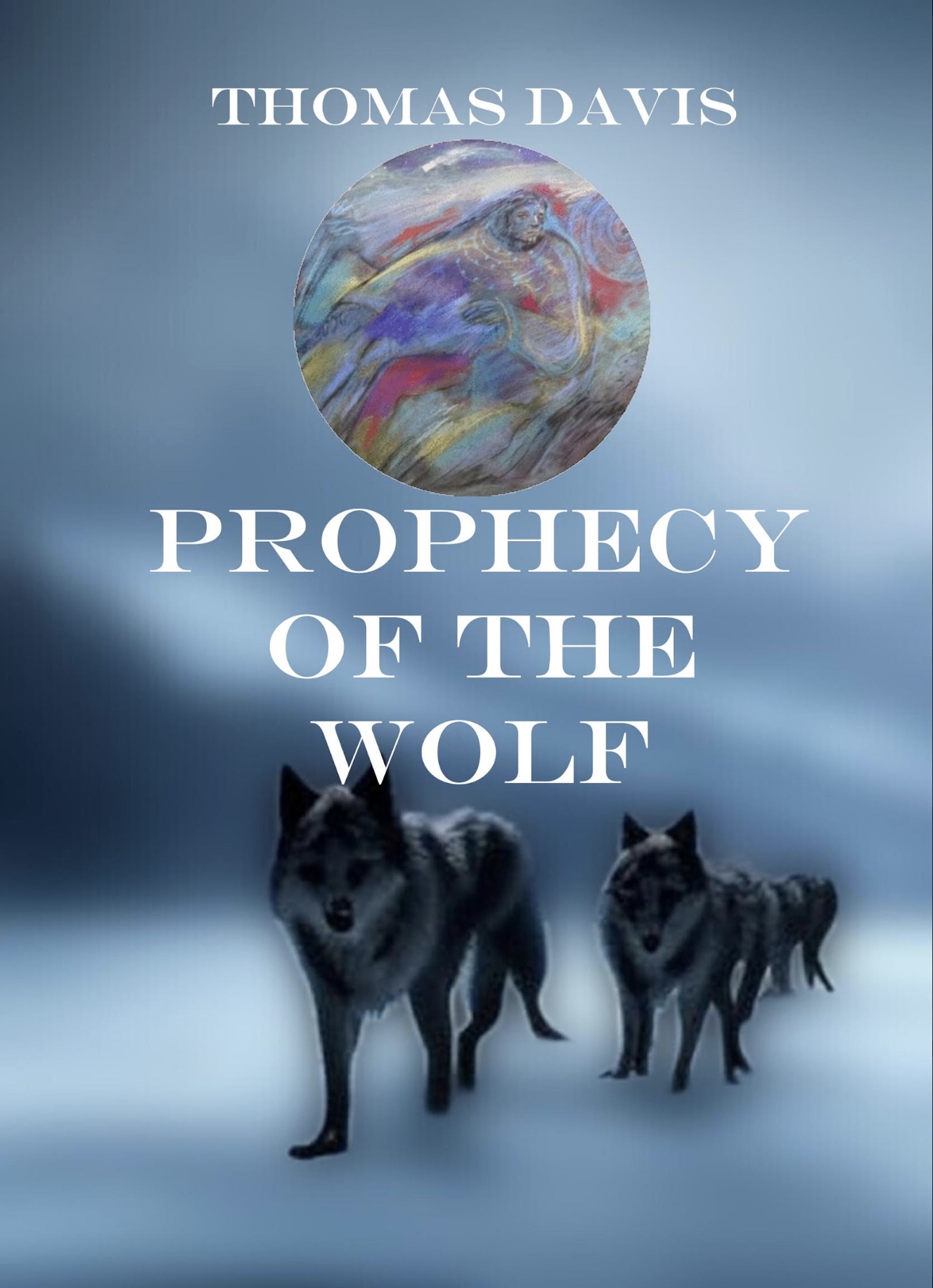
My new novel, The Prophecy of the Wolf, has been released by All Things That Matter Press! It’s available now at Otherworlds Books and More and Novel Bay in Sturgeon Bay, Wisconsin and Yardstick Books in Algoma, Wisconsin. Readers can also order it from almost any online venue.
I spent three years working on a historical novel that is set in the mid to late 1600s on the Door Peninsula and Washington Island as famous French priests and fur traders started to seriously impact the traditional lives of Native Americans. The Neshnabek, or Potawatomi Tribe, are at the heart of the story as Ogima tells about how he, as a young man, became embroiled in the affairs of Quapaw, a powerful waubeno that has had a vision given to him by a storyteller wolf. Quapaw, because of his shaman visions, starts to try to keep the Neshnabek from falling prey to the fur trade, the beguilement of French trade, and power of Christian conversion. The novel explores the largest themes possible as event follows event, eventually reaching a crescendo that has become a distant legend even in our time. In the process the lifestyle and beauty of Neshnabek civilization and culture becomes a beautiful backdrop to the action.
For World Poetry Day, from my novel, Prophecy of the Wolf, close to being released
Thomas Davis
The woman wrapped the child against the cold
And walked into the forest where the glow
Of moonlight pooled a deeply shadowed gold
Beneath the trees on softly shining snow.
She gathered wood, the baby on her back,
And built a fire, its warmth a dancing light
Upon a great flat rock protruding black
Into the lake’s infinity of white.
Then, in the dark, sat, death-still, beside
The flames, the baby in her arms, the smear
Of stars above their heads a radiant tide
Of silence singing to the ebbing year.
At last, her voice a permutation slipped
Into the night, she started chanting words
Born deep in spirit as the blackened crypt
Of waters stirred beneath lake ice, and birds,
As black as mourning shrouds, began to fly,
The forest stirring like the waters, wind
A whisper as the baby voiced a tiny cry
And shadowy trees began to sway and bend.
The woman got up on her feet, her voice
As silver as the moon, and sang as deer
Began to bound onto the ice: “Rejoice,”
The woman sang, and as she sang the fear
Felt during hours of pain-filled, labored birth
Dissolved into the biting wind and light
That danced with deer upon the lake, the earth
And living integrated with the night.
At our granddaughter Sophia's wedding, Ethel wrote one poem for the wedding that she read out loud during the ceremony. A friend of our daughter Mary read another poem by Ethel that was written 55 years ago during our courtship. Then, at the reception I sat down and wrote a poem commemorating the event as the mariachi band played and people people danced as sunlight streamed out of the clouds for the first time all day.
The poem Ethel read:Hope
Dear Grandmother,
today your great, great granddaughter
is getting married
to a fine, young man,
and they promise their love
is greater than their parents’ love
and their grandparents’ love.
They promise they will be happier
than their parents were
or their grandparents.
And they promise their children
will be loved more than all
the ancestors put together.
Dear Grandmother,
this is their promise,
and this is our hope.
The poem from 55 years ago:
How Could I Know?
It looks to me as though
you’ve been around, perhaps,
since time began—
and I have lived at least
as long.
Oh? Only that much time?
I’m sure there was no life
before for you or me.
How could I know your face
so well?
As well as some old rock
I’ve seen hang, clinging
to a mountain wall,
and I know what wave of brightness,
or of darkness, to expect there
waiting for me.
You step and make some rounded move.
I know beforehand which way to go.
How could I know? Unless. . .
You’ve been around, perhaps,
since time began.
I know I’ve lived at least as long.
The poem I wrote:At My Granddaughter’s Wedding
First the bald eagle above the bay,
water dancing light on lines of waves,
then cranes in the greening field,
Babies and parents communicating
with legs, moving necks, and wings in the sun,
and then the rumor of storms
brewing black clouds in the north,
stirring with big winds.
But then, after a night of worry,
the ceremony was to be outside,
the wedding day came, cloudy,
a fifty percent chance of rain.
But then the rain didn’t come.
Wedding roses lined paths
to the small wooden church.
Then, the words as ancient
as human spirits, were spoken
by the bride and groom,
and then the sun came out
as the mariachi celebration began,
as clouds thinned,
and my granddaughter and her love danced
as music rose into an evening sky—
and love was everywhere.
Everywhere.