Thomas Davis
I don’t know that I have ever written anything about one of Ethel’s poems. She’s my wife, after all, and my love for her is as deep as it was the day we were married over 57 years ago, but I thought I’d write on the Easter at least a note about this particular poem. It’s not the only poem she’s written that deserves an essay, of course. You could write a book on the poems that are meaningful and/or powerful enough to deserve commentary.
“Healing Journey” is about a particular place, at least on the surface. Ethel was raised on a dairy farm not too far from Wausau, Wisconsin, and near her parent’s farm is a park called Eau Claire Dells. It’s a beautiful place with black stone, waterfalls, a small canyon, and the deep woods of Wisconsin’s northern mixed hardwood conifer forest. Large maples, basswood, and other hardwood trees are mixed with a scattering of conifers.
The poem starts out with a rich description of the Eau Claire Dells, “the glacial forest” on a warm and humid day. The poet is climbing the high trail that leads to a bridge that spans the highest part of the small canyon that has a river in its depths, “black granite waters.” As daylight fades, “the moss-covered boulders looked like giants strewn/by some ancient glacier eons ago.” At this point, the poem takes on its metamorphic character. Time suddenly encompasses the ancient world as well as the present-day world. In the present, “the cold air rose around my legs” and “Water trickled down everywhere — through the moss carpet/thick with the red mushroom.”
The strong, specific nature of image are characteristic of all Ethel’s poetry, of course. The sense of water in the river and trickling “down everywhere” gives us a feeling of richness, of a different place where time is stretched out while still being as fluid as water, as the “everywhere” notion that is so powerful in this particular stanza. Time becomes a landscape, preparing us for the mysticism that is at the heart of what is to follow..
What is to follow is encompassed in “I had come here before, hoping to resolve a riddle,/but now I had a disease within my body and needed help.” The poet is not well, and the disease she has is troubling her, is a riddle she feels like she must solve. She needs help.
After this line the poet comes to a bridge over the canyon. The metaphors are obvious here. There are dark waters below as they run through dark granite. A bridge takes from one side to another. A canyon in a lot of Ethel’s poetry is a symbol that has to do with a depth that must be crossed. Granite is an age-old symbol of permanence, of rock the wears away only slowly over the ages, so the poet has come to a transition over the darkness of the deep (of death? Of the darkness in the world?) while she is ill, looking to cross over from all she is experiencing.
In these troubled times, it is not difficult to see the poet as a symbol for all humanity, ill, facing a chasm where dark waters are rushing over the dark river that is always next to its journey or below its passage.
The description of the bridge, “. . .black and strong,/made with spaces between the floor planks wide enough/to see the great height at which I was,” allowing the poet to see the river as “a black granite ribbon glistening in the dim light,” is a comforting image. The bridge is strong even if it’s boards are spaced wide apart and won’t collapse if the poet steps from the path she is in on to brave the crossing she intends to make.
Then she sees across the bridge in a clearing in the forest, the wilderness, “a large crowd of people./Their faces were as warm as their hands.” The symbol of hands is interesting here. A hand is also a bridge between human beings. We reach out our hand to help someone that needs that reaching out. In this cases the crowd of faces is also reaching out as the poet crosses the bridge, the chasm, and the dark river.
Then another character enters into the poem. There is no transition here. The nightingale doesn’t appear in anyway. Instead, it whispers: These are people that have helped you/In some way throughout your life.” In classic literature the nightingale is symbolic of beauty, love, and melancholy. It’s known for its beautiful song, which has been linked to spring, mourning, and love throughout history. In the contemporary world it often represents the muse or, sometimes, spiritual purity. I suspect Ethel is using the metaphor to represent the muse inside her without losing the older use of beauty, love, and melancholy. Crossing the chasm and the dark river is not celebratory. It is a spiritual journey that has a sense of purity inside it.
After seeing the people who have helped her during her life, day turns to night, but this is not the night of the dark waters in the river below the chasm. She turns around and crosses the bridge, and “the moon was beginning to shine on the water,” but not only in the water, but also in the poet. She has crossed the bridge and now is crossing it again, changed, especially in her spirit, in a significant way.
In that crossing, the poet “felt as if the sun was beginning to rise.” The dark waters and the chasm still exist, but as in the lines of “Bridge Over Troubled Water” by Simon and Garfunkel, crossing the bridge has eased her mind–as well as her spirit.
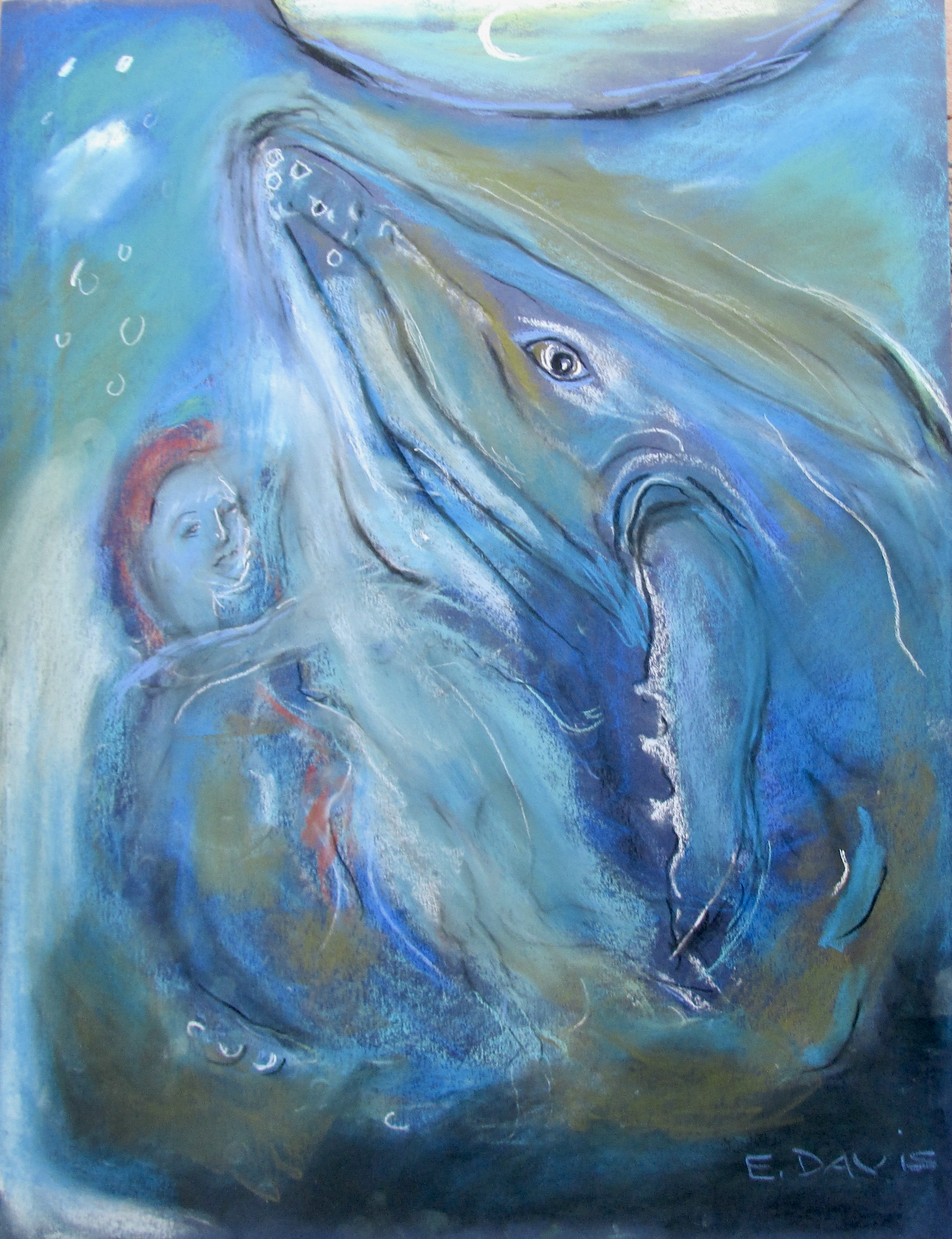
“Healing Journey” is a quintessential Easter poem. Many people reading Ethel’s poems see only the surface created by the powerful, often beautiful, images she evokes. However, like most great poets that deserve a wide audience, there’s often more than one way to read her poems. In a recent review of her latest book, The Woman and the Whale, Estella Lauter, the poet and critic, said that many of her poems are metaphors, and there is truth in that statement.
The resurrection from the fear/anxiety of illness, whether it is in a single human being or humankind as whole, to the spiritual purity in experiencing the whisper of the nightingale (whether it is a muse or spirituality–and what is the difference between these?), sings into any reader who looks this deeply into this poem.